Bac water: why bacteriostatic?
Bacteriostatic water is sterile water with 0.9% benzyl alcohol. What the preservative does, how it differs from sterile water, and when it is not the right choice in the lab.
Check the spelling or search for part of the name, such as BPC or GHK. Or choose below.
Popular searches
Go to
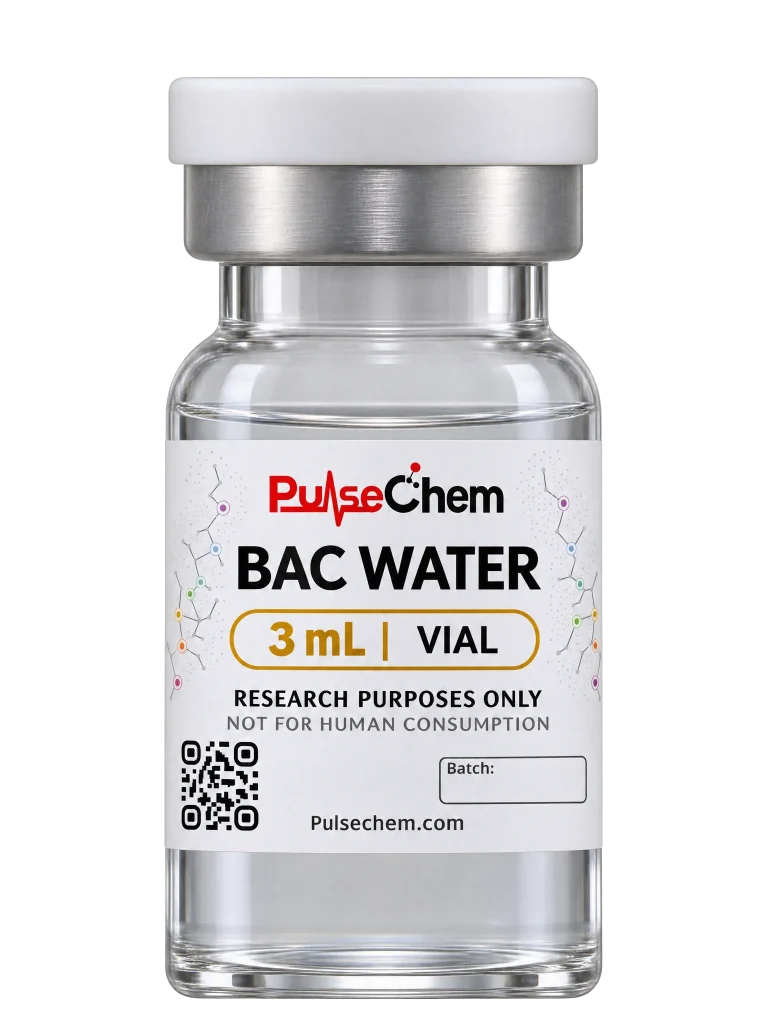
Bacteriostatic water is sterile water with 0.9% benzyl alcohol, a preservative that inhibits bacterial growth in an opened vial. When you buy bacteriostatic water from PulseChem for laboratory research, you choose from vials of 3, 10 and 30 ml, with a COA for every batch.
Price to follow. This product cannot be ordered yet.
Research Use Only. For laboratory research use only (in vitro). Not for human or animal use. The products are not medicines, foods, or cosmetics. They are not intended to diagnose, treat, cure, or prevent any disease. The information on this website has not been evaluated by the EMA, the Romanian National Agency for Medicines and Medical Devices (ANMDMR), or the FDA. Read the RUO policy
The batch number is on the vial label. You can find the certificate of analysis for that batch on the Lab results page or request it from us.
| Contents | 3 ml / 10 ml / 30 ml per vial |
|---|---|
| Intended use | For laboratory research use only (RUO) |
PulseChem carries bacteriostatic water in vials of 3, 10 and 30 ml, with the batch number on the label. Bac water is the short name, so a search for bac water for sale leads to the same product. Like every PulseChem product, it is intended for buyers aged 18 or over who are buying for laboratory research, as a guest or with an account.
Bacteriostatic means growth-inhibiting. Benzyl alcohol does not necessarily kill bacteria, but it keeps them from multiplying in an opened vial, so clean technique remains necessary. In the lab it is useful for working solutions where you take a small amount from the same vial over several days. For cell culture, labs often choose sterile water, because benzyl alcohol can affect cells. More in Bac water: why bacteriostatic?
Every batch has a COA. Use the batch number on the label to look up the certificate on Lab results.
Store an unopened vial according to the label and away from light; once opened, the in-use period on the label applies. Shipping is from Europe with tracking, within the EU only. Orders received and paid before 3 p.m. Central European time on a working day leave the same day; delivery takes 1–3 working days within Europe.
For laboratory research only, not for human or animal use.
Bacteriostatic water is listed by PulseChem in this web shop, in vials of 3, 10 and 30 ml. The price will follow; the product cannot be ordered yet. Every batch comes with a COA, and delivery takes 1–3 working days within Europe.
A vial of bacteriostatic water contains sterile water with 0.9% benzyl alcohol, in a volume of 3, 10 or 30 ml. The label should state the benzyl alcohol concentration, the volume, the batch number, the expiry date and the storage conditions. The COA for the batch is on Lab results.
Bacteriostatic water ships from Europe with tracking, within the EU only. Store an unopened vial according to the label and away from light. Once opened, the in-use period stated on the label applies, so write the opening date on the vial.
Bacteriostatic water contains 0.9% benzyl alcohol, while sterile water is water only. The benzyl alcohol inhibits bacterial growth in an opened vial, so you can draw from it more than once within the period on the label. Sterile water is intended for single use. For cell culture, sterile water is often the choice, because benzyl alcohol can affect cells.
Bacteriostatic water is sterile water with 0.9% benzyl alcohol. What the preservative does, how it differs from sterile water, and when it is not the right choice in the lab.
Peptides are supplied as a freeze-dried powder because they break down quickly in solution. What happens during freeze-drying, and what it means for storage.
Research Use Only is not a free pass. What the designation means, which limits come with it, and what a supplier and a laboratory need to do about it.
This conversation is stored so we can answer your question. More in the privacy policy.