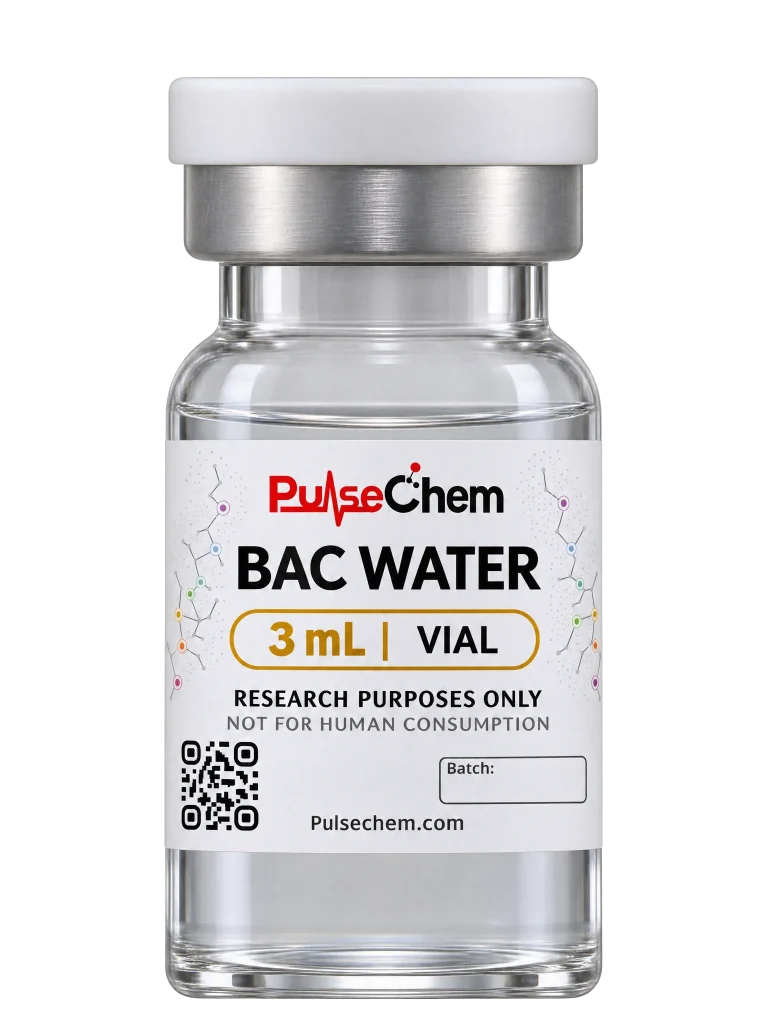
Bac water is short for bacteriostatic water: sterile water with 0.9% benzyl alcohol added. That single ingredient determines what it is good for, and what it is not.
What bacteriostatic means
Bacteriostatic means growth-inhibiting. Benzyl alcohol does not necessarily kill bacteria, but it prevents them from multiplying. If a single bacterium gets in when the vial is pierced, it does not develop into a contamination.
So the word also tells you what the preservative does not do: it does not make a contaminated liquid sterile. Clean technique is still required.
How it differs from sterile water
| Property | Sterile water | Bacteriostatic water |
|---|---|---|
| Composition | Water only | Water with 0.9% benzyl alcohol |
| After opening | No protection against growth | Growth is inhibited |
| Intended for | Single use | Repeated puncture within the period stated on the label |
| Effect on cells | No additive | Benzyl alcohol can affect cells |
When it is useful in the lab
The advantage lies in working solutions that you use over several days, drawing a small amount from the same vial each time. This lowers the risk that the stock becomes contaminated without anyone noticing.
When to choose something else
- Cell culture. Benzyl alcohol can change the growth and behavior of cells. For cell experiments, use sterile water or the buffer from your protocol, so that the preservative does not become a confounding factor.
- Sensitive assays. Benzyl alcohol absorbs UV light and can interfere with spectrophotometric measurements.
- Compounds that dissolve poorly in water. Some compounds need a different solvent or a different pH. Follow the product sheet.
When in doubt, include a solvent-only control. It shows whether the water itself has any effect in your measurement.
Storage and shelf life
Store an unopened vial as stated on the label, usually at room temperature and away from light. After the first puncture, a limited in-use period applies. It is stated on the label, and is often 28 days. Write the date of opening on the vial.
Do not use the liquid if it is cloudy, contains particles, or if the seal is damaged.
What the label should show
- the concentration of benzyl alcohol;
- the volume;
- the batch number and expiration date;
- the storage conditions.
Like all PulseChem products, bacteriostatic water is for laboratory research use only. See the RUO policy.
This article is background information on laboratory research. It is not medical advice or instructions for use. All products are for research use only.