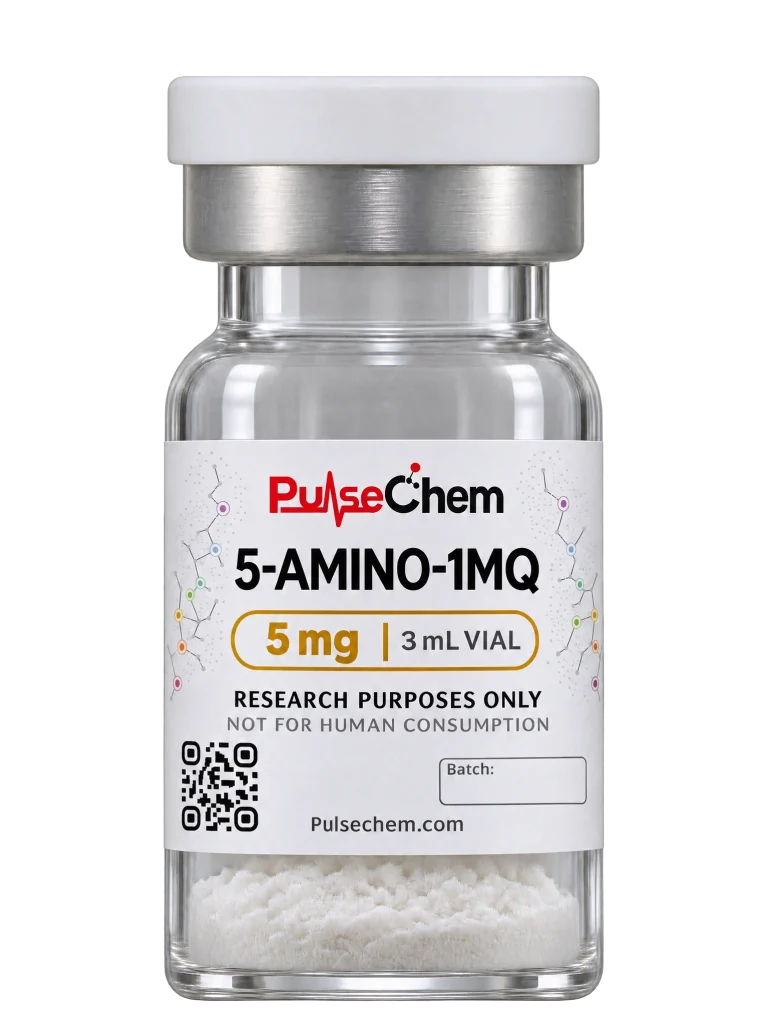
5-Amino-1MQ is not a peptide. It is a small organic molecule of twelve heavy atoms, built on the quinoline ring system. In the literature it has been described as an inhibitor of the enzyme nicotinamide N-methyltransferase (NNMT). At PulseChem it is listed in the catalogue as a research chemical.
Structure
The name is short for 5-amino-1-methylquinolinium. You read it like this: a quinoline (two fused rings, one of which contains a nitrogen atom), with a methyl group on that nitrogen (position 1) and an amino group at position 5. Because of the methyl group, the nitrogen carries a permanent positive charge. The molecule is therefore a cation, with the systematic name 1-methylquinolin-1-ium-5-amine.
| Property | Value |
|---|---|
| Compound class | Small organic molecule, quinolinium cation (not a peptide) |
| Molecular formula (cation) | C10H11N2+ |
| Molecular weight (cation) | 159.21 g/mol |
| Monoisotopic mass (cation) | 159.092 Da |
| CAS number (cation) | 685079-15-6 |
| PubChem CID (cation) | 950107 |
| Iodide salt | C10H11IN2, 286.11 g/mol, CAS 42464-96-0, CID 66522933 |
The product name 5-Amino-1MQ does not return a record in PubChem itself. The systematic name gives CID 950107, the cation on its own. The CAS number 685079-15-6 appears in that record with the FDA substance registry (GSRS) as its source, so it belongs to the cation. The iodide salt has its own record with its own number, and there 5-Amino-1MQ iodide is listed as a synonym. PubChem titles that record NNMTi, and its synonyms also include Compound 1k, NNMT inhibitor.
Salt and counterion
A cation does not exist on its own in a vial. It always comes with a negatively charged counterion, and together they form a salt. PubChem lists the iodide salt, with iodide as the counterion. The salt form of your batch is stated on the certificate of analysis.
That matters for the weight. The cation weighs 159.21, the iodide salt 286.11. Of the weight of the iodide salt, 159.21 / 286.11 = 55.6% is cation. So 10 mg of iodide salt contains about 5.6 mg of 5-amino-1-methylquinolinium; the rest is iodide. A different counterion gives a different figure. More on the difference between purity and content in What does 99% purity mean? and in the glossary.
The NNMT enzyme
According to UniProt (P40261), NNMT puts a methyl group on nicotinamide, using S-adenosylmethionine as the methyl donor. This produces N1-methylnicotinamide and S-adenosylhomocysteine. UniProt calls this a predominant clearance pathway for nicotinamide (vitamin B3). Because the enzyme consumes S-adenosylmethionine, UniProt also describes a role in how many methyl groups the cell has available for other methyltransferases.
Nicotinamide is also a building block of the coenzyme NAD+. Inferred from the same enzyme in the mouse (O55239), UniProt describes NNMT in white fat cells controlling the amount of NAD+ by consuming nicotinamide. That link is explained in What is NAD+?
What the research describes
One publication on this is that of Neelakantan and colleagues (2018) in Biochemical Pharmacology. The authors describe small molecules that inhibit NNMT selectively and can cross the cell membrane, and they studied such inhibitors in mice that had become obese on a high-fat diet.
This article gives no results in numbers and no amounts. It concerns an animal model, which says nothing about the research material in your lab. No use is described and no effect is promised.
Status
5-Amino-1MQ is not a medicine. In PubChem, neither the cation nor the iodide salt has any information on a medicine, an authorisation or a clinical trial (checked on 14 November 2026). The material sold by PulseChem is intended for laboratory research only and not for humans or animals. What that means is explained in RUO explained.
In the lab
- Identity. Because the molecule already carries a charge, positive-mode mass spectrometry shows the cation itself at m/z 159.09, not a molecule with an extra proton. That is different from a peptide.
- Purity. HPLC measures what share of the signal comes from 5-amino-1-methylquinolinium. The counterion does not count there, but it does count towards the weight of the powder.
- Storage. PubChem gives no storage conditions. Follow the label, and keep the powder closed, dry and dark.
What sets a peptide apart from a small molecule like this one is covered in What are peptides?
In the shop. PulseChem supplies 5-Amino-1MQ in 5 mg, for laboratory research only. You can look up the certificate for your batch, including the counterion, by batch number on Lab results; the checks every batch goes through are listed in the laboratory standard.
Read more: What is NAD+?, What is a COA? and What does 99% purity mean?
Sources
Consulted in November 2026.
- 5-Amino-1-methylquinolinium (PubChem, NCBI), CID 950107: C10H11N2+, molecular weight 159.21, CAS 685079-15-6 (source FDA GSRS, UNII PMX593N4N3), systematic name
- NNMTi (5-amino-1-methylquinolinium iodide) (PubChem, NCBI), CID 66522933: C10H11IN2, molecular weight 286.11, CAS 42464-96-0 (source FDA GSRS, UNII K9G33W2TTZ), synonym 5-Amino-1MQ iodide
- Nicotinamide N-methyltransferase (human) (UniProt), P40261: function, with the role in white fat cells inferred from the mouse enzyme (O55239)
- Neelakantan H et al. Selective and membrane-permeable small molecule inhibitors of nicotinamide N-methyltransferase reverse high fat diet-induced obesity in mice (Biochem Pharmacol 2018;147:141-152), PMID 29155147
This article is background information on laboratory research. It is not medical advice or instructions for use. All products are for research use only.