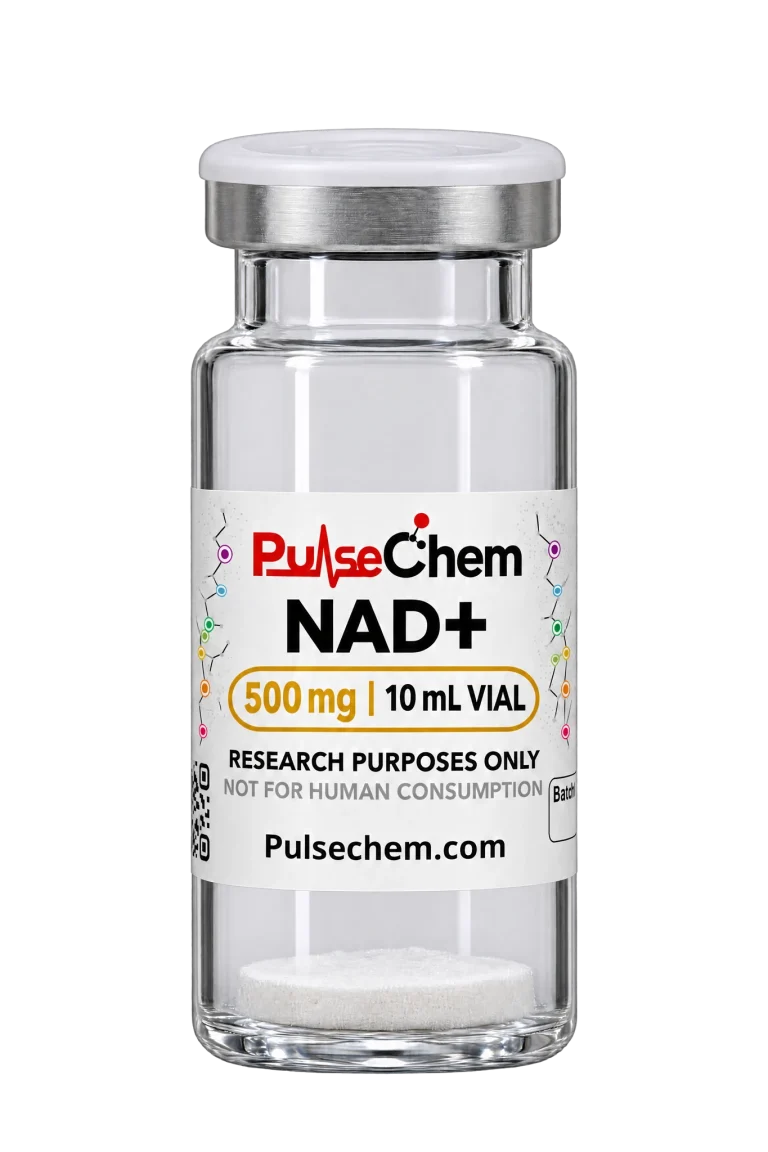
NAD+ sits in the PulseChem catalogue under Mitochondria and cell metabolism, but it is not a peptide. It is a coenzyme: a small molecule that enzymes need in order to carry out their reaction. According to the description in PubChem, it is found widely in nature and takes part in numerous enzymatic reactions. At PulseChem it is a laboratory reagent.
Structure
The full name is nicotinamide adenine dinucleotide. A dinucleotide is made of two nucleotides, and here that is literally the case: one nucleotide carries nicotinamide, the other carries adenine. Each nucleotide has a sugar (ribose) and a phosphate group, and the two phosphate groups together form the bridge between the two halves. PubChem describes it as ribosylnicotinamide 5′-diphosphate coupled to adenosine 5′-phosphate by a pyrophosphate linkage.
| Property | Value |
|---|---|
| Compound class | Dinucleotide, coenzyme (not a peptide) |
| International nonproprietary name (INN) | nadide |
| Molecular formula | C21H27N7O14P2 |
| Molecular weight (average) | 663.4 g/mol |
| Monoisotopic mass | 663.109 Da |
| CAS number | 53-84-9 |
| EC number | 200-184-4 |
| PubChem CID | 5892 |
The plus in NAD+ refers to the nitrogen in the nicotinamide ring, which carries a positive charge. You can see it in the systematic name as pyridin-1-ium. The record PulseChem uses (CID 5892, nadide) is the form in which that charge is balanced by a negatively charged phosphate group, so the molecule as a whole is neutral. If you search PubChem for NAD+, you get four records: variants of the same substance, some of them with a different charge. The record for the full name is CID 5892.
Next to 53-84-9, PubChem also lists the CAS number 64417-72-7. That second number belongs to the monolithium salt, which has its own EC number (264-884-1) and its own PubChem record (CID 6454884), with data from the European Chemicals Agency (ECHA). The number for NAD+ itself is 53-84-9. Why such a number is useful is explained in the glossary.
What NAD+ does in the cell
Carrying electrons: NAD+ and NADH
PubChem quotes the classic definition from Dorland’s medical dictionary: NAD serves as an electron carrier in numerous enzymatic reactions by being alternately oxidized (NAD+) and reduced (NADH). In such a reaction NAD+ takes up electrons and becomes NADH; in a later reaction NADH hands them on again.
You can see the difference in the formula. NADH (PubChem CID 439153) has the formula C21H29N7O14P2 and a molecular weight of 665.4. That is two hydrogen atoms more than NAD+, roughly 2 mass units. In a mass spectrum the two forms can therefore be told apart.
Supplying ADP-ribose
The PubChem description of nadide (from the NCI Thesaurus) names a second role: NAD+ is not only a coenzyme in redox reactions, it also acts as a donor of ADP-ribose. In those reactions NAD+ is not switched back and forth but used as a building block. Two examples from UniProt, the protein database:
- PARP1 (poly ADP-ribose polymerase 1) transfers the ADP-ribose group of NAD+ to proteins and builds chains from it, on average 20 to 30 units long. UniProt describes a key role in DNA repair.
- SIRT1 is an NAD-dependent deacetylase: an enzyme that removes acetyl groups from proteins and needs NAD+ to do so. It belongs to the sirtuin family.
This is biochemistry as the databases describe it. It says nothing about what a powder in a vial does, and it is not a property of the product.
The link with NNMT
The nicotinamide in the name connects NAD+ to another enzyme: nicotinamide N-methyltransferase, NNMT for short. According to UniProt, NNMT puts a methyl group on nicotinamide, using S-adenosylmethionine as the methyl donor. The product is N1-methylnicotinamide. UniProt calls this a predominant clearance pathway for nicotinamide (vitamin B3) and, inferred by similarity with a related enzyme, describes NNMT in white fat cells controlling the amount of NAD+ by consuming nicotinamide.
That is why NNMT turns up in research on 5-Amino-1MQ, a small molecule described as an inhibitor of this enzyme.
Status
Nadide has an international nonproprietary name (INN), but that does not make it an authorised medicine. In the ChEMBL data shown by PubChem (checked on 14 November 2026), phase 2 is the highest clinical phase for nadide. As a chemical, nadide is registered under REACH in the EU, with EC number 200-184-4.
The NAD+ sold by PulseChem is a laboratory reagent. It is not a medicine and not a dietary supplement, and it is not intended for humans or animals. What the research-use label means is explained in RUO explained.
In the lab
- Identity. In positive-mode mass spectrometry you expect the protonated molecule around m/z 664.1: the monoisotopic mass of 663.1 plus one proton. NADH sits about 2 units higher. How to read such a spectrum is covered in How to read a mass spectrum.
- Purity. This follows from the HPLC chromatogram on the certificate of analysis, just as for a peptide.
- Moisture. PubChem, citing the Merck Index, calls nadide a highly hygroscopic white solid. The powder attracts water. Keep the vial closed, and let a cold vial reach room temperature before you open it so that no condensation gets in.
- Storage. PubChem gives no storage temperature. Follow the label. General storage rules are in Storing peptides in the lab; the same basics apply to a dry powder such as NAD+: cool, dry and dark.
In the shop. PulseChem supplies NAD+ in 500 mg and 1000 mg, for laboratory research only. You can look up the certificate for your batch by batch number on Lab results; the checks every batch goes through are listed in the laboratory standard.
Read more: What is 5-Amino-1MQ?, What is MOTS-c?, What is SS-31 (elamipretide)? and What are peptides?
Sources
Consulted in November 2026.
- Nadide (PubChem, NCBI), CID 5892: C21H27N7O14P2, molecular weight 663.4, CAS 53-84-9 and 64417-72-7, EC numbers, INN, descriptions from Dorland and the NCI Thesaurus, physical description (Merck Index), REACH registration and highest clinical phase (ChEMBL)
- NADH (PubChem, NCBI), CID 439153: C21H29N7O14P2, molecular weight 665.4
- EINECS 264-884-1 (PubChem, NCBI), CID 6454884: monolithium salt of NAD, C21H26LiN7O14P2, CAS 64417-72-7 and EC number 264-884-1 (source ECHA)
- Poly [ADP-ribose] polymerase 1 (PARP1, human) (UniProt), P09874
- NAD-dependent protein deacetylase sirtuin-1 (SIRT1, human) (UniProt), Q96EB6
- Nicotinamide N-methyltransferase (NNMT, human) (UniProt), P40261
- Nadide, CHEMBL1234613 (ChEMBL, EMBL-EBI), highest clinical phase
This article is background information on laboratory research. It is not medical advice or instructions for use. All products are for research use only.