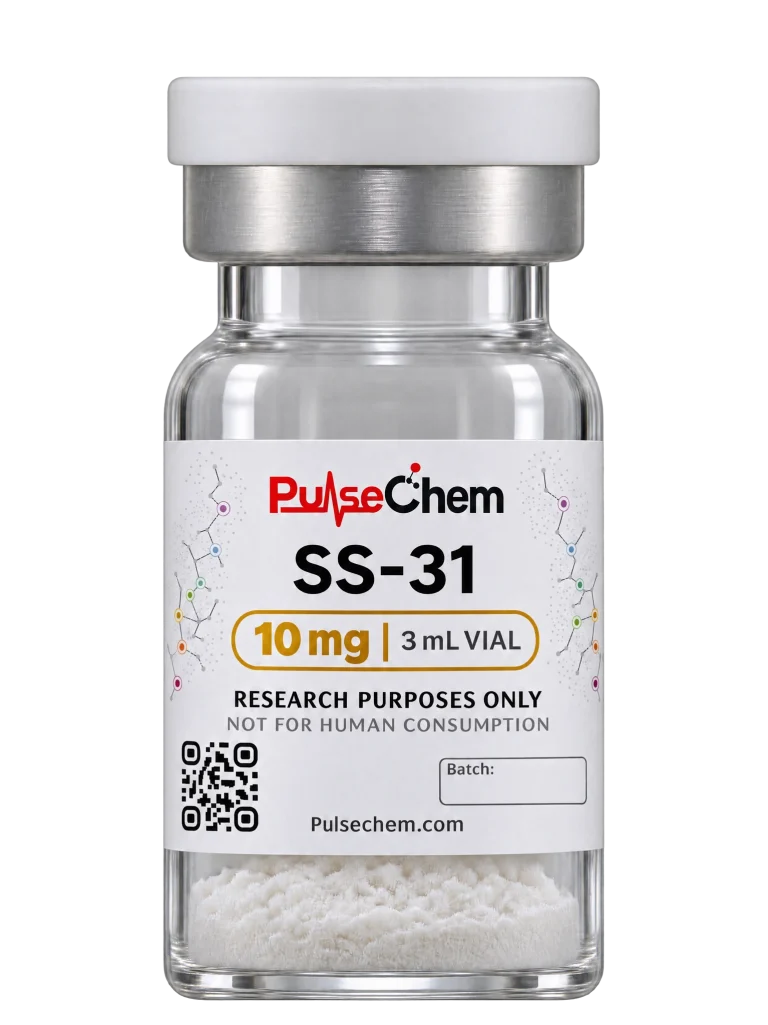
SS-31 is a synthetic peptide of four amino acids. In the databases it also appears under the international nonproprietary name elamipretide. The letters SS stand for the Szeto-Schiller peptides, a series of short peptides that accumulate in the inner membrane of the mitochondrion. Since 2025 there has been an approved medicine with elamipretide in the United States, which is why there is a separate section below on the difference between that medicine and a research chemical.
Structure
The chain is H-D-Arg-Dmt-Lys-Phe-NH2. Two positions differ from the standard amino acids: position 1 is D-arginine, the mirror image, and position 2 is Dmt, 2′,6′-dimethyltyrosine, a tyrosine with two extra methyl groups. The C-terminus is an amide. The molecular formula is C32H49N9O5, the molecular mass 639.8 and the CAS number 736992-21-5. PubChem lists the compound as CID 11764719.
In one-letter code the chain reads RXKF: the X stands for Dmt, for which no letter exists. The PubChem synonym list includes SS-31, Bendavia, MTP-131, Ocuvia and Forzinity.
Origin
The SS peptides are named after Hazel Szeto (Weill Cornell Medicine, New York) and Peter Schiller (Institut de recherches cliniques de Montréal). They arrived at the series through synthetic opioid peptides designed in Schiller’s laboratory, when such short chains turned out to enter cells and accumulate in the mitochondrion. According to Weill Cornell Medicine’s own account of the approval, Szeto founded in 2006 the company now known as Stealth BioTherapeutics, which developed the compound further.
What the research describes
The research is mainly about binding to cardiolipin, a negatively charged phospholipid in the inner mitochondrial membrane.
- Birk et al. (2013), Journal of the American Society of Nephrology. Using a fluorescent analogue of the peptide, the authors show that SS-31 binds cardiolipin with high affinity. They report that the SS-31/cardiolipin complex inhibits the peroxidase activity of cytochrome c, and that in rats the cristae of the mitochondria were preserved during renal ischaemia.
- Szeto (2014), British Journal of Pharmacology. A review that describes the compound as the first cardiolipin-protective compound in its class. Earlier publications called it a mitochondria-targeted antioxidant; this article updates that account.
- Mitchell et al. (2020), Journal of Biological Chemistry. The authors measure that the peptide binds in the interfacial region of lipid membranes and changes the surface electrostatics of model membranes and mitochondrial membranes.
That is what has been measured and published, in cell and animal models and in model membranes.
Status as of 14 November 2026
The US FDA granted accelerated approval on 19 September 2025 to Forzinity, with elamipretide as its active substance, for Barth syndrome, a rare inherited mitochondrial disorder. The applicant is Stealth BioTherapeutics. Under accelerated approval the manufacturer still has to carry out a confirmatory trial. PubChem has taken that approval into the description on its record.
In the European Union there is no marketing authorisation. Elamipretide does hold EU orphan designation for Barth syndrome (number EU/3/21/2430, granted on 20 May 2021). The EMA states explicitly with such a designation that it does not mean the medicine is authorised: a separate marketing authorisation is required for that.
A medicine and a research chemical are not the same thing
An approval covers one finished product: a particular manufacturer, a defined composition, its own manufacturing process, a package leaflet and supervision under medicines law. The SS-31 sold here is not that product. It is a research chemical for laboratory use, not a medicine, and not intended for use in humans or animals. The fact that the active substance shares a chemical name changes none of that.
What the research-use designation means is set out in RUO explained. What it means legally for the seller and the buyer is on the Liability and research use page.
In the laboratory
SS-31 is a lyophilised powder. Store it as the label states: cold, dry and dark, with the batch number in the lab notebook.
When checking identity, the non-coded building block is the main point: a calculator that only knows the twenty standard amino acids will give the wrong mass for RXKF, because Dmt weighs more than tyrosine. The amide at the end accounts for roughly 1 unit against a free acid. At 639.8 this is a small peptide, so any gap between the calculated and the measured mass is immediately visible. Purity comes from the HPLC chromatogram on the certificate of analysis.
In the shop. PulseChem supplies SS-31 in 10 mg and 30 mg, for laboratory research only. The certificate for your batch is on the product page and on the Lab results page.
Further reading: What is MOTS-c?, What are peptides?, How to read a peptide sequence and RUO explained.
Sources
Consulted in November 2026.
- Elamipretide (SS-31) (PubChem, NCBI), CID 11764719: sequence H-D-Arg-Dmt-Lys-Phe-NH2, one-letter code RXKF, C32H49N9O5, molecular mass 639.8, CAS 736992-21-5, synonyms and INN
- Birk AV et al. The mitochondrial-targeted compound SS-31 re-energizes ischemic mitochondria by interacting with cardiolipin (J Am Soc Nephrol 2013;24(8):1250-1261), PMID 23813215
- Szeto HH. First-in-class cardiolipin-protective compound as a therapeutic agent to restore mitochondrial bioenergetics (Br J Pharmacol 2014;171(8):2029-2050), PMID 24117165
- Mitchell W et al. The mitochondria-targeted peptide SS-31 binds lipid bilayers and modulates surface electrostatics as a key component of its mechanism of action (J Biol Chem 2020;295(21):7452-7469), PMID 32273339
- FDA Grants Accelerated Approval to First Treatment for Barth Syndrome (FDA, news release of 19 September 2025)
- Drug Trials Snapshots: Forzinity (FDA)
- EU/3/21/2430, orphan designation for the treatment of Barth syndrome (EMA)
- The Winding Road from Bench to FDA Approval for First Mitochondria-Targeting Drug (Weill Cornell Medicine, on Szeto, Schiller and Stealth BioTherapeutics)
This article is background information on laboratory research. It is not medical advice or instructions for use. All products are for research use only.