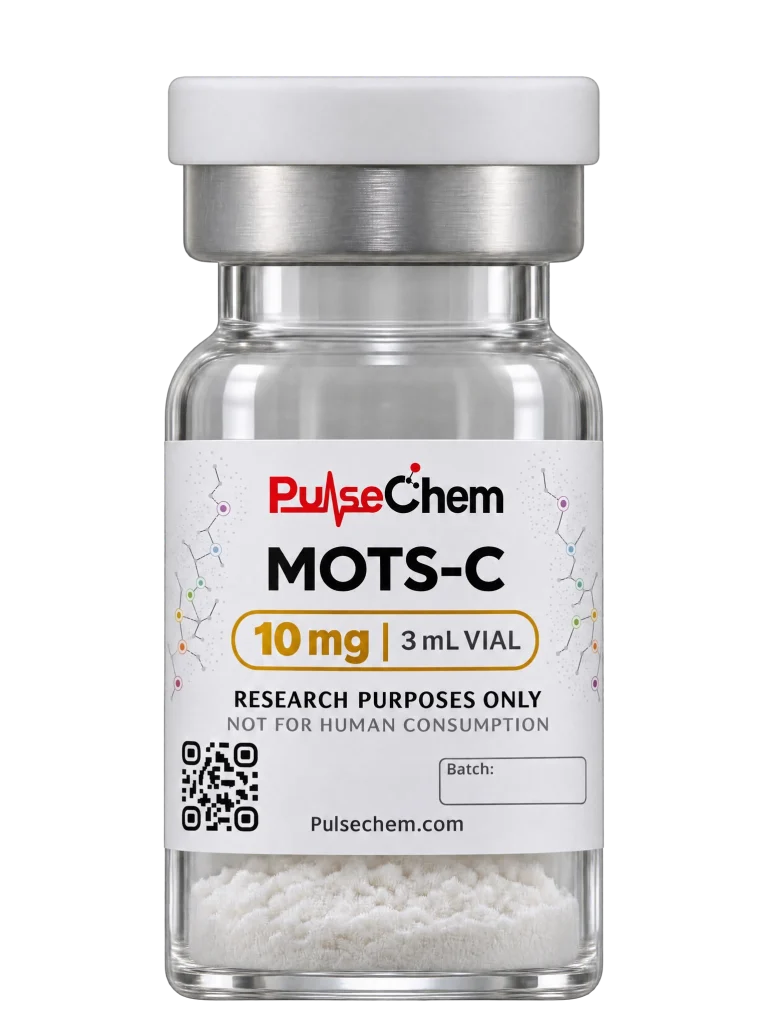
Almost every peptide in a cell is encoded in the DNA of the nucleus. MOTS-c is not. This peptide of sixteen amino acids is read from a short stretch of mitochondrial DNA, which makes it one of the best known members of a group called the mitochondrial-derived peptides.
Structure
The sequence is Met-Arg-Trp-Gln-Glu-Met-Gly-Tyr-Ile-Phe-Tyr-Pro-Arg-Lys-Leu-Arg, in one-letter code MRWQEMGYIFYPRKLR. Both ends are free: a free amino group at the N-terminus and a free acid at the C-terminus. The molecular formula is C101H152N28O22S2, the molecular mass 2174.6 and the CAS number 1627580-64-6. PubChem lists the compound as CID 146675088.
The two sulfur atoms in the formula come from the two methionines, at positions 1 and 6. Methionine is sensitive to oxidation: that is one of the chemical degradation routes Manning and colleagues set out in their review of the stability of protein pharmaceuticals (2010). For a powder in a closed vial, it is mainly a reason to keep it cool, dry and dark.
The discovery
MOTS-c was described in 2015 by Lee and colleagues in Cell Metabolism. They found a short open reading frame of 51 base pairs within the gene for the mitochondrial 12S ribosomal RNA. What makes it unusual is that the peptide is made outside the mitochondrion, using the standard genetic code: with the different mitochondrial code, the same stretch would not yield a usable peptide. The authors deposited the sequence in GenBank as KP715230.
MOTS-c is not alone. In the region of the 16S rRNA, humanin and six small peptides named SHLP1 to SHLP6 have been described, found by an in silico search around the humanin gene by Cobb and colleagues (2016). The family name points to that origin: peptides encoded in the mitochondrial genome.
What the research describes
The work on MOTS-c is about cells and about mice. The 2015 paper describes measurements of metabolism in cell models and in mice, with the authors setting out a route to the enzyme AMPK by way of the folate cycle and purine biosynthesis. AMPK is an enzyme that governs the energy balance inside a cell.
Since then, mainly review articles have followed. Lee, Kim and Cohen summarised the field in Free Radical Biology and Medicine in 2016, and Zheng, Wei and Wang discussed the state of play and the open questions in Frontiers in Endocrinology in 2023. Those reviews name the main limitation themselves: most of the evidence comes from cell and animal models, and the step to humans has largely not been taken.
This article reports those findings because they have been published, not as a property of the product. No application is described and no effect is promised.
Status
MOTS-c is not a medicine and is not authorised as one anywhere. The PubChem record lists no development phase and no approved indication; it links (as of 14 November 2026) to one entry in the ClinicalTrials.gov register. That register lists a phase 2a study, number NCT07505745, titled “MOTS-c for Improving Insulin Sensitivity in Adults With Prediabetes and Overweight/Obesity (MOTS-MET)”, set up as randomised, double-blind and placebo-controlled. The register lists the study as recruiting, with no results posted. A registration does not mean there are results, let alone an authorisation.
In the laboratory
The powder is lyophilised. Store it as the label states: cold, dry and dark, with the batch number in the lab notebook.
Knowing the structure helps when checking identity. Three arginines and one lysine make the peptide strongly basic, so in mass spectrometry it appears at several charge states: the same compound then gives several peaks, each at a different mass-to-charge ratio. Oxidation of one methionine raises the mass by about 16 units and shows up as a separate peak. What belongs on the certificate is set out in What is a COA?
The material is for laboratory research only (RUO) and has not been assessed for use in humans or animals.
In the shop. PulseChem supplies MOTS-c in 10 mg and 40 mg. Search for your batch certificate by batch number on the Lab results page; the checks each batch goes through are set out in the laboratory standard.
Further reading: What is SS-31 (elamipretide)?, Why lyophilise peptides? and What is a COA?
Sources
Consulted in November 2026.
- MOTS-c (PubChem, NCBI), CID 146675088: sequence MRWQEMGYIFYPRKLR, C101H152N28O22S2, molecular mass 2174.6, CAS 1627580-64-6
- Lee C, Zeng J, Drew BG et al. The mitochondrial-derived peptide MOTS-c promotes metabolic homeostasis and reduces obesity and insulin resistance (Cell Metab 2015;21(3):443-454), PMID 25738459, doi 10.1016/j.cmet.2015.02.009
- Lee C, Kim KH, Cohen P. MOTS-c: a novel mitochondrial-derived peptide regulating muscle and fat metabolism (Free Radic Biol Med 2016;100:182-187), PMID 27216708, doi 10.1016/j.freeradbiomed.2016.05.015
- Zheng Y, Wei Z, Wang T. MOTS-c: a promising mitochondrial-derived peptide for therapeutic exploitation (review, Front Endocrinol 2023;14:1120533), PMID 36761202, doi 10.3389/fendo.2023.1120533
- Cobb LJ, Lee C, Xiao J et al. Naturally occurring mitochondrial-derived peptides are age-dependent regulators of apoptosis, insulin sensitivity, and inflammatory markers (Aging (Albany NY) 2016;8(4):796-809), PMID 27070352, doi 10.18632/aging.100943: humanin and SHLP1 to SHLP6 in the 16S rRNA region
- MOTS-c for Improving Insulin Sensitivity in Adults With Prediabetes and Overweight/Obesity (MOTS-MET) (ClinicalTrials.gov), NCT07505745, phase 2a, recruiting, no results posted (consulted on 14 November 2026)
- Manning MC, Chou DK, Murphy BM, Payne RW, Katayama DS. Stability of protein pharmaceuticals: an update (Pharm Res 2010;27(4):544-575), PMID 20143256
This article is background information on laboratory research. It is not medical advice or instructions for use. All products are for research use only.