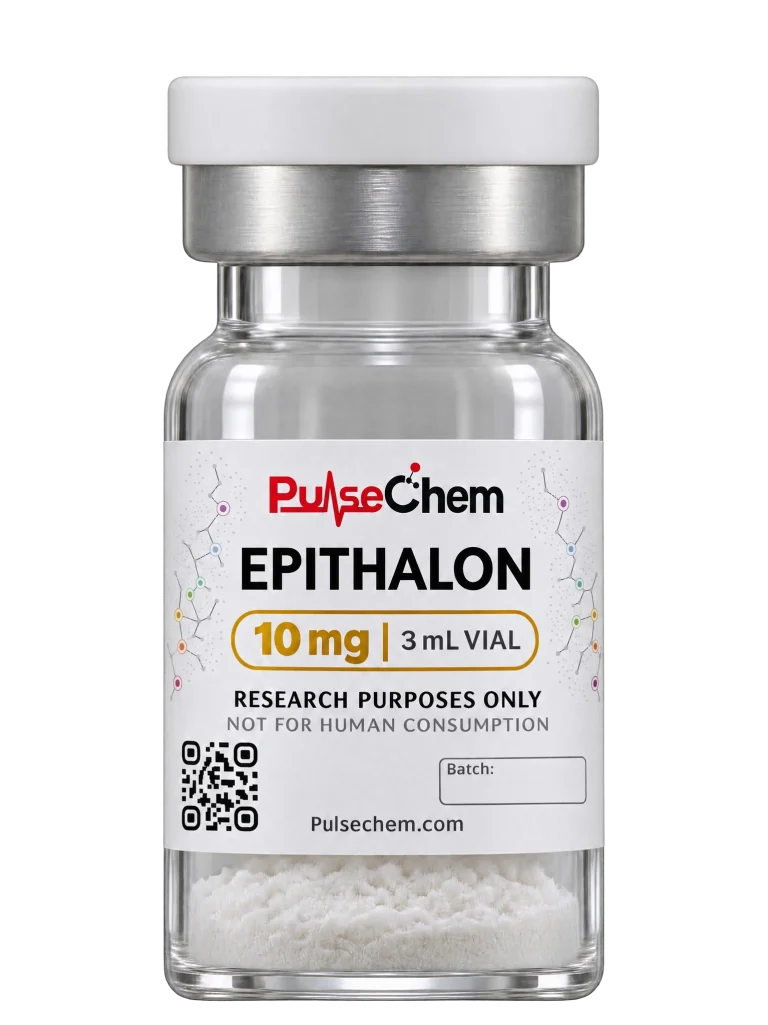
Epithalon is one of the shortest peptides in this knowledge base: four amino acids. It comes from the bioregulator research of the group around Vladimir Khavinson in Saint Petersburg, and the literature also calls it epitalon, epithalone or simply AEDG.
Structure
The sequence is H-Ala-Glu-Asp-Gly-OH, in one-letter code AEDG: alanine, glutamic acid, aspartic acid, glycine. Both ends are free. The molecular formula is C14H22N4O9 and the molecular mass 390.35. PubChem lists the compound as CID 219042, with CHEBI:230091 and DrugBank DB17882 as cross-references.
Two of the four building blocks are acidic amino acids, and the formula shows it: nine oxygen atoms to fourteen carbon atoms. A peptide with two free carboxyl groups next to the free acid at the C-terminus is distinctly acidic in water.
Two CAS numbers
PubChem lists two valid CAS numbers and one deprecated number on this record, and it is useful to know where each comes from.
- 307297-39-8 belongs to the tetrapeptide itself. This number comes from the sources that hold the record under the name epitalon or epithalon: ChemIDplus, DrugBank, the EPA database DSSTox and the FDA substance register (GSRS, with UNII O65P17785G).
- 64082-79-7 comes from one ChemIDplus record filed under the name epithalamin, the starting material from which the peptide was derived.
- 357960-60-2 is listed as a deprecated number on the ChemIDplus record under the name epithalon.
So anyone checking a number on a label or a certificate of analysis may meet different numbers for what is one record in the database. What a CAS number does and does not pin down is explained in the glossary.
Origin
Epithalon was not isolated from a natural source but designed. According to a 2025 review in the International Journal of Molecular Sciences, the peptide was synthesised on the basis of the amino acid composition of epithalamin, an extract of the bovine pineal gland. That makes epithalamin something other than epithalon: the extract is a mixture, while the peptide is one defined compound of four building blocks. Findings about the extract therefore do not carry over to the peptide as a matter of course.
The work comes from the school of the Russian researcher Vladimir Khavinson, who in the papers on AEDG is affiliated with the Institute of Bioregulation and Gerontology in Saint Petersburg. That group speaks of peptide bioregulators. In a 2021 systematic review it describes short peptides as chains of two to seven amino acids.
What the research describes
The oldest widely cited study is by Khavinson, Izmaylov, Obukhova and Malinin, published in 2000 in Mechanisms of Ageing and Development. Fruit flies (Drosophila melanogaster, Canton-S strain) were given the peptide in the culture medium, only during the stage from egg to larva. The authors report an adult lifespan 11 to 16 per cent above that of the control group, at very low concentrations, and note that the effect did not increase with the amount given.
A more recent and independent study is by Al-Dulaimi and colleagues at Brunel University London, published in 2025 in Biogerontology. They treated human cell lines in culture and measured an increase in telomere length, in normal cells together with higher hTERT expression and more telomerase activity, and in two breast cancer cell lines through the ALT route. A correction to that article appeared in November 2025: the wrong images had been printed as Figs. 1, 2 and 3. This is a small in vitro study on a handful of cell lines.
That is the picture: most of the evidence comes from cell and animal models, a large part of it from a single research group. The 2025 review also describes a few clinical studies, one of them at the institute in Saint Petersburg, and concludes that the mechanism of action remains unclear. On that basis nothing can be established about an effect in humans. This article reports the findings because they have been published, not as a property of the product.
Status
Epithalon is not a medicine and is not authorised as one. The PubChem record has no drug and medication section at all: no development phase, no approved indication and no international nonproprietary name (INN). The EMA medicines database lists no marketing authorisation for the compound either (data of 13 November 2026).
In the laboratory
The powder is lyophilised. Store it as the label states: cold, dry and dark, with the batch number in the lab notebook.
When checking identity, the small mass is the point to watch. At 390.35, epithalon is lighter than most peptides in this catalogue, and in mass spectrometry it sits in the range where salts, solvent residues and fragments also appear. Because of the two acidic building blocks, the peptide behaves differently in HPLC than a basic peptide: the choice of pH and of the ion in the mobile phase determines where the peak comes out. That is why a certificate should state the method as well as the number.
The material is for laboratory research only (RUO) and has not been assessed for use in humans or animals.
In the shop. PulseChem supplies Epithalon in 10 mg and 50 mg, in the Bioregulators category. Search for your batch certificate by batch number on the Lab results page.
Further reading: What are peptides?, How to read a peptide sequence, What is a COA? and Why peptides are lyophilised.
Sources
Consulted in November 2026.
- Epitalon (PubChem, NCBI), CID 219042: sequence H-Ala-Glu-Asp-Gly-OH (AEDG), C14H22N4O9, molecular mass 390.35, the CAS numbers 307297-39-8 and 64082-79-7 with their sources, the deprecated number 357960-60-2, and the synonyms Epithalon and Epithalone
- Araj SK, Brzezik J, Madra-Gackowska K, Szeleszczuk L. Overview of Epitalon: Highly Bioactive Pineal Tetrapeptide with Promising Properties (Int J Mol Sci 2025;26(6):2691), PMID 40141333: the synthesis based on the amino acid composition of epithalamin, the survey of research with a section on clinical studies, and the conclusion that the mechanism of action is unclear
- Khavinson VK, Popovich IG, Linkova NS, Mironova ES, Ilina AR. Peptide Regulation of Gene Expression: A Systematic Review (Molecules 2021;26(22):7053), PMID 34834147: short peptides of 2 to 7 amino acids
- Khavinson VK, Izmaylov DM, Obukhova LK, Malinin VV. Effect of epitalon on the lifespan increase in Drosophila melanogaster (Mech Ageing Dev 2000;120(1-3):141-149), PMID 11087911
- Al-Dulaimi S, Thomas R, Matta S, Roberts T. Epitalon increases telomere length in human cell lines through telomerase upregulation or ALT activity (Biogerontology 2025;26(5):178), PMID 40908429, doi 10.1007/s10522-025-10315-x, with the correction (Biogerontology 27(1):1, online 15 November 2025, PMID 41240216, doi 10.1007/s10522-025-10326-8): wrong images in Figs. 1, 2 and 3
- EMA medicines database (data of 13 November 2026): no marketing authorisation for epitalon
This article is background information on laboratory research. It is not medical advice or instructions for use. All products are for research use only.