What is a COA?
A certificate of analysis tells you what is in a batch and how it was measured. How to read one, and how to check that it belongs to your vial.
Check the spelling or search for part of the name, such as BPC or GHK. Or choose below.
Popular searches
Go to
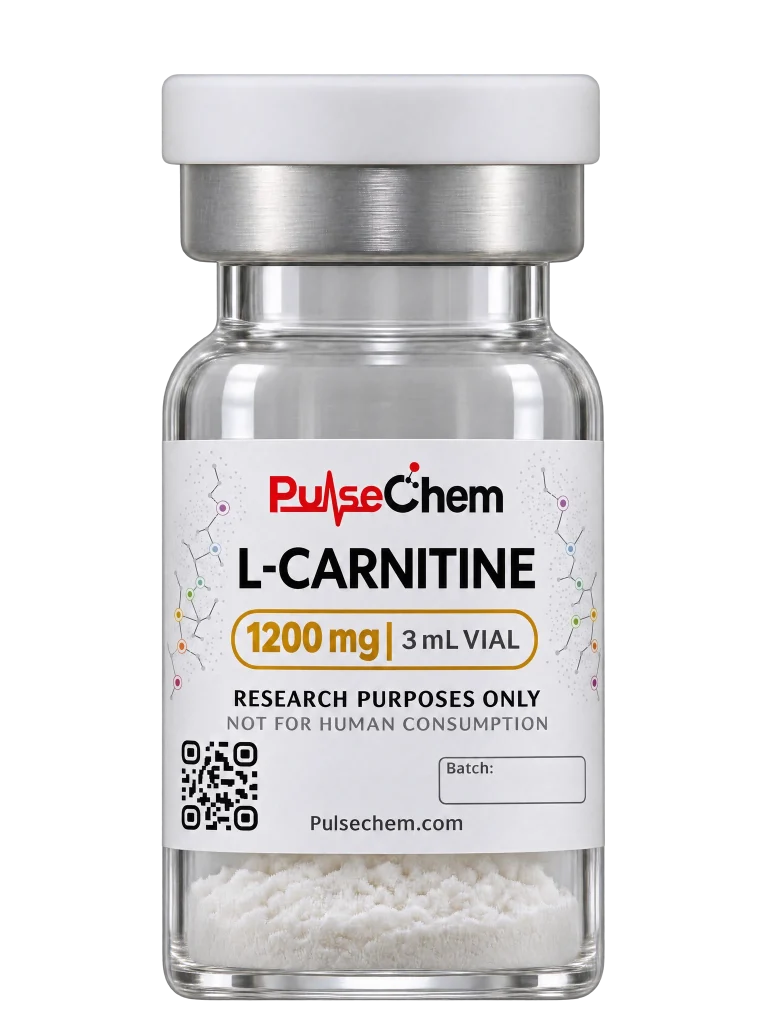
L-Carnitine is a small molecule: the (R)-enantiomer of carnitine, a zwitterion with a trimethylammonium group and a carboxylate group. Buy L-Carnitine for laboratory research from PulseChem: 1200 mg per vial, ≥99% purity by HPLC and a COA for every batch.
€92.45 incl. VAT · €76.40 excl. VAT
In stock
Volume discount
Research Use Only. For laboratory research use only (in vitro). Not for human or animal use. The products are not medicines, foods, or cosmetics. They are not intended to diagnose, treat, cure, or prevent any disease. The information on this website has not been evaluated by the EMA, the Romanian National Agency for Medicines and Medical Devices (ANMDMR), or the FDA. Read the RUO policy
This is how solutions are prepared in the lab.
Step 1 of 8: Disinfect
The stoppers of both vials are wiped with an alcohol swab.
For laboratory research use only (in vitro). Not for human or animal use.
The batch number is on the vial label. You can find the certificate of analysis for that batch on the Lab results page or request it from us.
| Contents | 1200 mg per vial |
|---|---|
| Purity | ≥99% (HPLC) |
| Intended use | For laboratory research use only (RUO) |
At PulseChem, L-Carnitine comes in vials of 1200 mg, with the batch number on the label. Handle and store the material following the label and COA. One vial costs €92.45 including VAT.
The L-Carnitine for sale here can be ordered by anyone aged 18 or over who buys for laboratory research, as a guest or with an account. At checkout, you confirm that the product is intended for research.
PubChem describes L-Carnitine, citing ChEBI, as the (R)-enantiomer of carnitine. The trimethylammonium group carries a permanent positive charge, the carboxylate group a negative one. A molecule with both charges is called a zwitterion. Its CAS number is 541-15-1.
Gulewitsch and Krimberg described carnitine in 1905 in the Zeitschrift für physiologische Chemie, after isolating it from meat extract. The name comes from the Latin carnis, meaning flesh.
Every batch of L-Carnitine passes through an external laboratory: HPLC for purity (≥99%) and mass spectrometry for identity. In positive mode, the molecule is expected with one extra proton, calculated at about m/z 162.1. Find the certificate by batch number on Lab results.
Store L-Carnitine closed, cool, dry and dark, as the label and COA indicate. The vials travel in insulated packaging with tracking, and we add a cold pack in warm weather. We ship from Europe and only within the EU; delivery takes 1–3 working days within Europe. An order received and paid before 3 p.m. Central European time on a working day is shipped the same day.
For laboratory research only, not for human or animal use.
L-Carnitine is available from PulseChem in this web shop. The 1200 mg vial costs €92.45 including VAT, and L-Carnitine is in stock. Orders received and paid before 3 p.m. Central European time on a working day ship the same day; delivery takes 1–3 working days within Europe. Every batch comes with a COA.
A vial of L-Carnitine contains 1200 mg. The label shows the amount and the batch number, and with that number you find the COA for your batch with the purity by HPLC. Storage and handling follow the label and COA.
The purity of L-Carnitine is measured for every batch by an external laboratory using HPLC, and only a batch at ≥99% is released. Mass spectrometry confirms identity. Look up the COA with the batch number on your vial, via Lab results.
L-Carnitine is not a peptide but a small, naturally occurring compound of 161.20 g/mol. It has no amino acid chain: it is a derivative of butyric acid with a hydroxy group and a trimethylammonium group. PulseChem supplies L-Carnitine as a research chemical, for laboratory research only.
A certificate of analysis tells you what is in a batch and how it was measured. How to read one, and how to check that it belongs to your vial.
A purity of 99% tells you about the composition of the peptide, not about the amount in the vial. What the number measures, and what it does not.
Peptides are supplied as a freeze-dried powder because they break down quickly in solution. What happens during freeze-drying, and what it means for storage.
This conversation is stored so we can answer your question. More in the privacy policy.