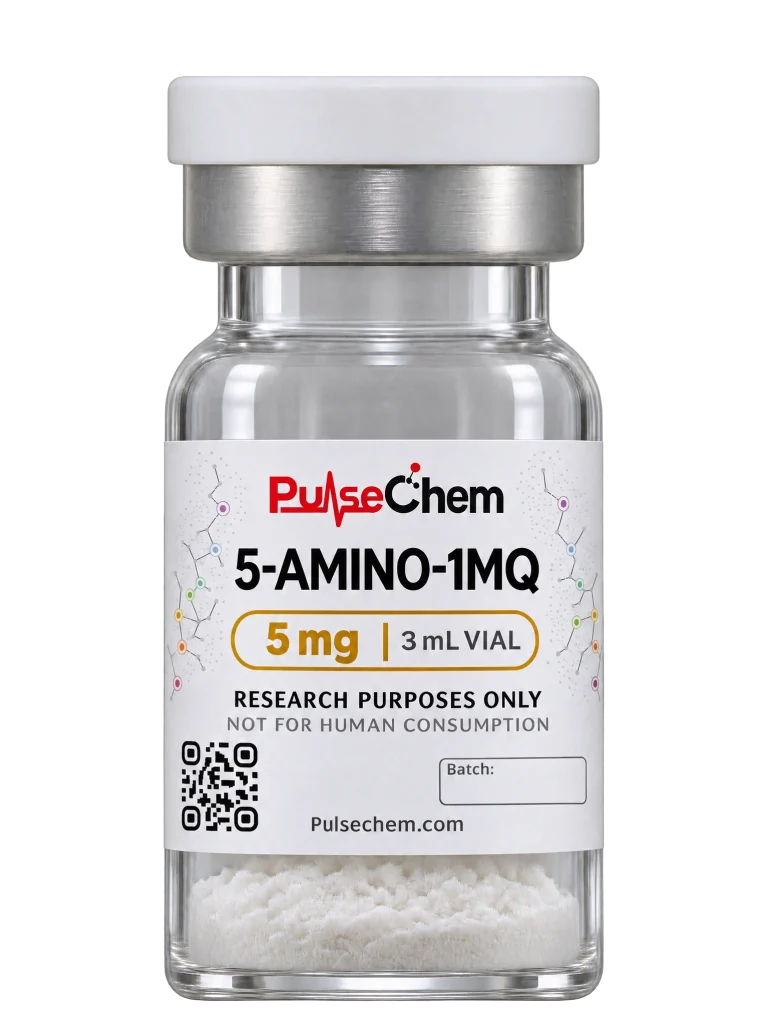
What is AOD-9604?
AOD-9604 is a synthetic peptide of sixteen amino acids modelled on the C-terminal end of human growth hormone. Structure, the 176-191 numbering, research and status.
Check the spelling or search for part of the name, such as BPC or GHK. Or choose below.
Popular searches
Go to
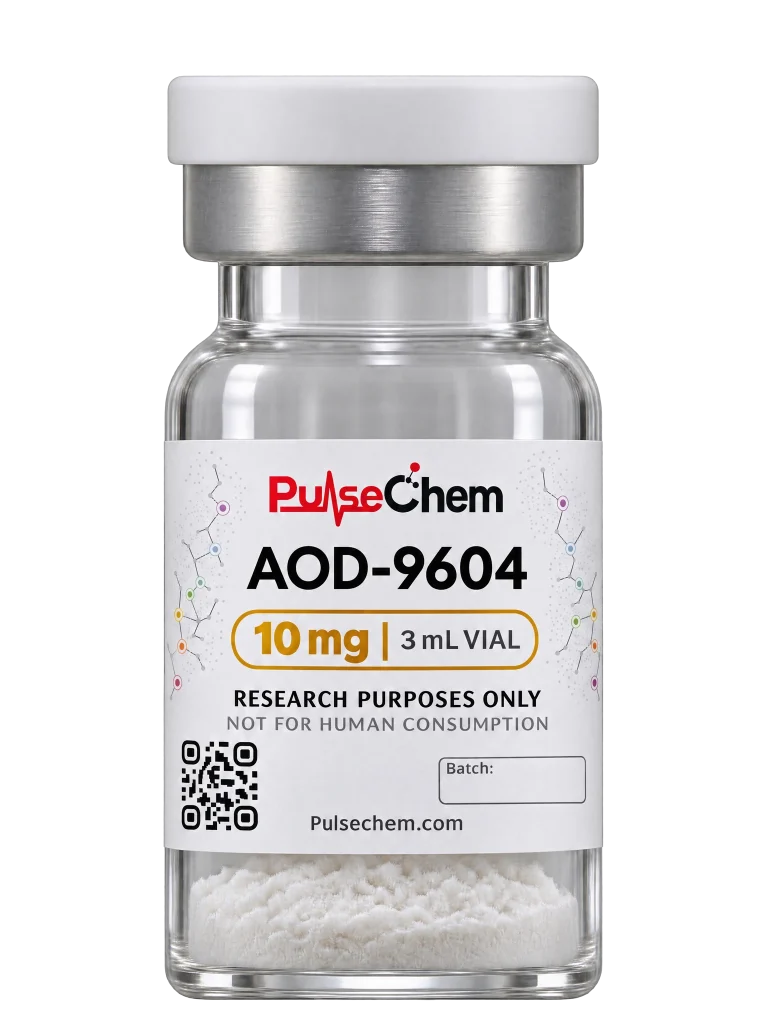
AOD-9604 is a synthetic peptide of 16 amino acids, modeled on the end of human growth hormone, with tyrosine in the first position. Buy AOD-9604 for laboratory research from PulseChem: 10 mg of lyophilized powder per vial, ≥99% purity by HPLC and a COA for every batch.
€70.45 incl. VAT · €58.22 excl. VAT
In stock
Volume discount
Research Use Only. For laboratory research use only (in vitro). Not for human or animal use. The products are not medicines, foods, or cosmetics. They are not intended to diagnose, treat, cure, or prevent any disease. The information on this website has not been evaluated by the EMA, the Romanian National Agency for Medicines and Medical Devices (ANMDMR), or the FDA. Read the RUO policy
This is how solutions are prepared in the lab.
Step 1 of 8: Disinfect
The stoppers of both vials are wiped with an alcohol swab.
For laboratory research use only (in vitro). Not for human or animal use.
Research area: Metabolism Gut
Sequence: H-YLRIVQCRSVEGSCGF-OH
Structure from PubChem, CID 71300630. Schematic in 3D, not a measured structure.
Schematic view of the chain. This is not a measured 3D structure.
Point to an amino acid or use the arrow keys to see its name.
Drag or use the arrow keys to rotate the diagram. Point to a bead to see the name of the amino acid.
The chain has 16 amino acids, shown here from the N-terminus to the C-terminus. There is 1 bridge within the chain. Calculated average molecular mass: 1,815.1 g/mol. Compare this figure with the mass on the certificate of analysis.
On the research map: Stomach, pancreas, and adipose tissue Gut and gut-brain axis
The batch number is on the vial label. You can find the certificate of analysis for that batch on the Lab results page or request it from us.
| Contents | 10 mg per vial |
|---|---|
| Sequence | H-Tyr-Leu-Arg-Ile-Val-Gln-Cys(1)-Arg-Ser-Val-Glu-Gly-Ser-Cys(1)-Gly-Phe-OH |
| Purity | ≥99% (HPLC) |
| Intended use | For laboratory research use only (RUO) |
AOD-9604 for sale at PulseChem comes as 10 mg per vial. The peptide is supplied as lyophilized powder in a sealed glass vial, with strength and batch number on the label. One vial costs €70.45 including VAT.
You can order if you are 18 or over and buy for laboratory research, with or without an account, and you confirm research use at checkout. More research peptides for sale are in the same shop, each with a COA for every batch.
AOD-9604 follows the C-terminal end of human growth hormone. Positions 2 to 16 match positions 177 to 191 of the mature hormone (UniProt P01241). The first position holds tyrosine where the hormone has phenylalanine. That is why the peptide is also called Tyr-hGH 177-191, and elsewhere fragment 176-191.
Two cysteines form a disulfide bridge that closes the middle of the chain into a small ring. Its CAS number is 221231-10-3. AOD-9604 is not authorized as a medicine. More in What is AOD-9604?
Every batch of AOD-9604 is analyzed externally: HPLC determines purity (≥99%) and mass spectrometry confirms identity. With this peptide, the disulfide bridge counts: the bridged form weighs about 2 mass units less than the open form. The batch number on the label takes you to the right COA on Lab results.
Store AOD-9604 in the closed vial, cool, dry and dark, as the label and COA state. We ship from Europe in insulated packaging with tracking and add a cold pack in warm weather. On working days, we ship the same day for orders received and paid before 3 p.m. Central European time. Delivery takes 1–3 working days within Europe; we deliver within the EU only.
For laboratory research only, not for human or animal use.
AOD-9604 is available from PulseChem in this web shop. A 10 mg vial costs €70.45 including VAT, and AOD-9604 is in stock. Orders received and paid before 3 p.m. Central European time on a working day ship the same day, and delivery takes 1–3 working days within Europe. Every batch has a COA you can view online.
A vial of AOD-9604 contains 10 mg of the peptide as lyophilized powder, in a sealed glass vial. The label shows the strength and the batch number. With that number, you can find the COA for exactly your batch, with the purity by HPLC and the identity check.
AOD-9604 can be ordered by anyone aged 18 or over who buys it for laboratory research. You can order as a guest or with an account, and you confirm research use at checkout. PulseChem ships only to addresses within the European Union.
AOD-9604 was studied at Monash University in Australia; Heffernan and colleagues published on it in 2001 in Endocrinology. The peptide is modeled on the C-terminal end of human growth hormone, with tyrosine in the first position. PubChem describes it as an N-tyrosyl analog of a fragment of that hormone.
AOD-9604 is a synthetic peptide of sixteen amino acids modelled on the C-terminal end of human growth hormone. Structure, the 176-191 numbering, research and status.
A peptide is a short chain of amino acids joined by peptide bonds. How peptides differ from proteins, which peptides occur in nature, and which items in the catalog are not peptides.
Which chemical reactions make a peptide degrade, which amino acids are sensitive to them, and how to handle temperature, moisture, light and record keeping in the lab.
This conversation is stored so we can answer your question. More in the privacy policy.