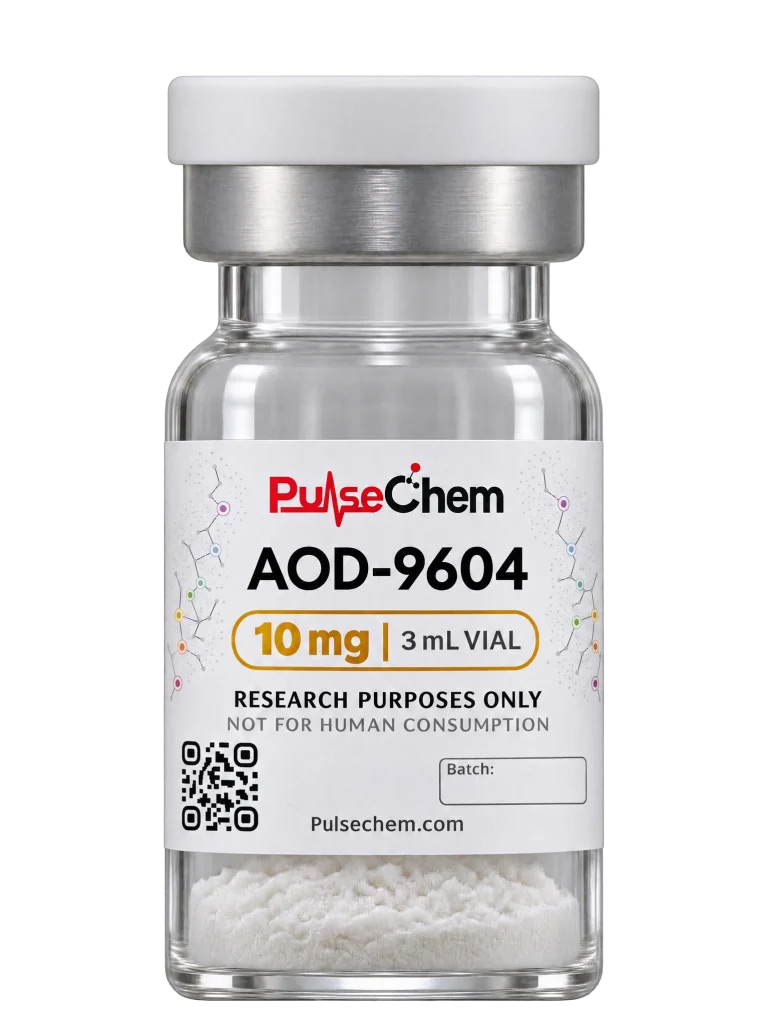
AOD-9604 is a synthetic peptide of sixteen amino acids. It is modelled on the end of human growth hormone (hGH): the last fifteen amino acids of the hormone, with a tyrosine in front. PubChem, citing MeSH, describes it as an N-tyrosyl analogue of a fragment of human growth hormone. AOD-9604 is not authorised as a medicine.
Structure
The sequence is H-Tyr-Leu-Arg-Ile-Val-Gln-Cys-Arg-Ser-Val-Glu-Gly-Ser-Cys-Gly-Phe-OH, in one-letter code YLRIVQCRSVEGSCGF. The two cysteines, at positions 7 and 14, are joined by a disulfide bridge, so the middle part of the chain forms a small ring. Both ends are free: an amino group at the start and an acid at the end.
| Property | Value |
|---|---|
| Compound class | Synthetic peptide of 16 amino acids |
| Disulfide bridge | Cys7-Cys14 |
| Termini | Free N-terminus, free acid at the C-terminus |
| Molecular formula | C78H123N23O23S2 |
| Molecular weight (average) | 1815.1 g/mol |
| Monoisotopic mass | 1813.86 Da |
| CAS number | 221231-10-3 |
| PubChem CID | 71300630 |
PubChem also lists a deprecated CAS number, 386264-39-7. The valid number is 221231-10-3. How to read a sequence with a disulfide bridge is covered in How to read a peptide sequence.
Numbering: 176-191 or 177-191?
In some places AOD-9604 is called fragment 176-191, in others Tyr-hGH 177-191. Both names refer to the same peptide. You can see why once you put the growth hormone itself next to AOD-9604.
UniProt gives a precursor protein of 217 amino acids for human growth hormone (P01241): a signal peptide at positions 1 to 26, followed by the mature hormone at positions 27 to 217. The mature hormone therefore has 191 amino acids, the last 191 of the precursor. The IUPHAR/BPS Guide to Pharmacology gives the same number in PubChem for somatropin, which has the same sequence as the hormone made by the body. Counting that way, the last sixteen positions (176 to 191) read FLRIVQCRSVEGSCGF.
- Positions 177 to 191 of the hormone (LRIVQCRSVEGSCGF) are identical to positions 2 to 16 of AOD-9604.
- Position 176 of the hormone is phenylalanine (F). AOD-9604 has tyrosine (Y) there.
That is why Tyr-hGH 177-191 is the more precise name: a tyrosine followed by fragment 177-191. The name 176-191 counts the sixteen places, but the first amino acid is not the one in the hormone. The two cysteines of AOD-9604 sit at the places numbered 182 and 189 in the hormone.
One more pitfall: the MeSH entry terms in PubChem also call the peptide Tyr-somatostatin (177-191). Somatostatin is a different hormone, with its own PubChem record. The description in the same record does refer to growth hormone. A name on its own is therefore no proof of identity; the sequence and the CAS number are.
Origin and research
According to the DrugBank data in PubChem, AOD9604 is a synthetic analogue of a domain of human growth hormone and has been investigated in obesity and osteoporosis. DrugBank and MeSH write it without a hyphen, as AOD9604.
Research started with the fragment itself. First came work on synthetic hGH 177-191 (PubMed 7987248), then mouse studies with AOD9604 (PubMed 11713213 and 11673763). This article gives no results: these are animal models, and they say nothing about the research material in your lab.
Status
AOD-9604 is not authorised as a medicine. With DrugBank as the source, PubChem only states that AOD9604 has been investigated in obesity and osteoporosis; it lists no authorisation as a medicine (checked on 14 November 2026). ChEMBL also lists AOD9604 under the code LAT-8881, with phase 2 as the highest development phase. Under that code, ClinicalTrials.gov lists completed phase 1 and phase 2 studies by Lateral Pharma, such as NCT03865953 and NCT04153409. The material sold by PulseChem is for laboratory research only and not for humans or animals. What that label means is explained in RUO explained.
In the lab
- The disulfide bridge in the mass spectrum. When the bridge forms, the two cysteines lose two hydrogen atoms between them. The bridged form is therefore about 2 units lighter than the form without the bridge (2 × 1.008 = 2.016). With an average mass of 1815.1 for the bridged form, the reduced form comes to about 1817.1. In electrospray ionisation you expect peaks for the molecule with one, two and three protons, around m/z 1814.9, 907.9 and 605.6 (from the monoisotopic mass). If the bridge is opened, for example by a reducing agent during sample preparation, every peak shifts by 2 divided by the charge: 2 at one charge, 1 at two charges. More in How to read a mass spectrum; another peptide with a disulfide bridge is oxytocin.
- Purity. Purity follows from the HPLC chromatogram on the certificate of analysis. Peptide content is a different figure; the difference is explained in What does 99% purity mean?.
- Storage. The powder is lyophilised. Keep it closed, cool, dry and dark, at the temperature on the label, and let a cold vial reach room temperature before you open it.
In the shop. PulseChem supplies AOD-9604 in 10 mg, for laboratory research only. You can look up the certificate for your batch by batch number on Lab results; the checks every batch goes through are listed in the laboratory standard.
Read more: What is CJC-1295?, What is ipamorelin?, What is oxytocin? and How to read a peptide sequence
Sources
Consulted in November 2026.
- Aod-9604 (PubChem, NCBI), CID 71300630: sequence and disulfide bridge 7-14 (HELM), C78H123N23O23S2, molecular weight 1815.1, CAS 221231-10-3 and deprecated CAS 386264-39-7, descriptions from MeSH and DrugBank
- Somatotropin (human) (UniProt), P01241: precursor protein of 217 amino acids, signal peptide 1-26, mature hormone 27-217, disulfide bridge 208-215
- growth hormone 1 (PubChem, substance 178101641, deposited by the IUPHAR/BPS Guide to Pharmacology): somatropin with the 191-amino-acid sequence of the endogenous hormone
- Somatostatin (PubChem, NCBI), CID 16129706
- PubMed 7987248: synthetic hGH 177-191
- PubMed 11713213 and PubMed 11673763: mouse studies with AOD9604
- LAT-8881 (ChEMBL, EMBL-EBI), CHEMBL6068615: synonyms AOD-9604 and AOD9604, highest phase 2
- NCT03865953 (phase 2) and NCT04153409 (phase 2), studies with LAT8881 by Lateral Pharma, both completed (ClinicalTrials.gov)
This article is background information on laboratory research. It is not medical advice or instructions for use. All products are for research use only.