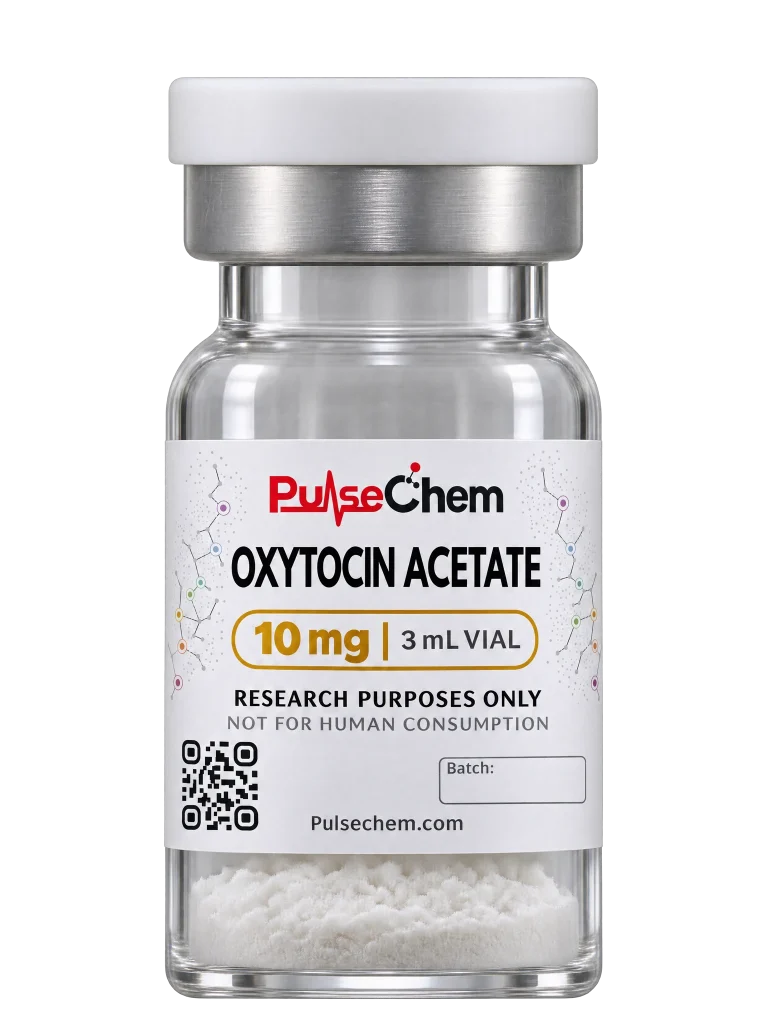
Oxytocin is a nine-residue peptide hormone and was the first peptide hormone ever made by chemical synthesis. This article is about the chemistry and the history of the compound.
Structure
PubChem describes oxytocin as a cyclic nonapeptide with the sequence CYIQNCPLG. The chain is short, but it has two features that you see again in the mass: a disulfide bridge and an amide at the end.
| Property | Value |
|---|---|
| Compound class | Cyclic peptide hormone of nine amino acids (nonapeptide) |
| Sequence, three-letter | H-Cys-Tyr-Ile-Gln-Asn-Cys-Pro-Leu-Gly-NH2 |
| Sequence, one-letter | CYIQNCPLG |
| Ring closure | Disulfide bridge between Cys1 and Cys6 |
| C-terminus | Amide, not a free acid |
| Molecular formula | C43H66N12O12S2 |
| Molecular weight (average) | 1007.2 g/mol |
| Monoisotopic mass | 1006.436 Da |
| CAS number | 50-56-6 |
| PubChem CID | 439302 |
The first six residues form a ring through the disulfide bridge, with Pro-Leu-Gly-NH2 hanging off it as a tail. PubChem writes this as H-Cys(1)-Tyr-Ile-Gln-Asn-Cys(1)-Pro-Leu-Gly-NH2, where the number in brackets marks the two linked cysteines. How to read a line like that is explained in How to read a peptide sequence.
The acetate salt
The powder in this catalogue is oxytocin acetate. PubChem has a separate record for it (CID 12004215): the peptide together with acetic acid, with the formula C45H70N12O14S2 and a molecular weight of 1067.2. The difference from 1007.2 is one molecule of acetic acid, about 60. A counterion like this balances the charge of the peptide and is part of the weight of the powder. That is why a vial holds less peptide than the weight on the label suggests; how much acetate and bound water a batch contains follows from the analysis. The difference between purity and peptide content is explained in What does 99% purity mean?
Oxytocin and vasopressin
Vasopressin is built the same way: nine amino acids, a disulfide bridge between Cys1 and Cys6, and an amide at the end. For arginine vasopressin (CID 644077) PubChem gives the sequence CYFQNCPRG. So the two compounds differ in two places: position 3 (Ile or Phe) and position 8 (Leu or Arg). The description in the PubChem record for oxytocin notes the same difference at residues 3 and 8. Two amino acids are enough to make two different compounds, which is one reason to look at the sequence on a certificate and not only at the name.
History
According to the description in PubChem, Sir Henry H. Dale first identified oxytocin in 1906. The same description gives the architecture shared by the neurohypophysial hormones: nine amino acids with a disulfide bridge between the cysteines at positions 1 and 6.
PubChem records that the American biochemist Vincent du Vigneaud synthesised oxytocin in the mid-1950s and was later recognised with a Nobel prize for that work. That was the 1955 Nobel Prize in Chemistry, with the committee’s citation reading “for his work on biochemically important sulphur compounds, especially for the first synthesis of a polypeptide hormone”. Oxytocin was thus the first peptide hormone to be synthesised.
That work was done step by step in solution, years before Merrifield’s solid support existed. How peptides have been made and purified since then is set out in How are peptides made?
Status
Oxytocin is an active substance in authorised medicines. In its drug development overview, PubChem lists the status Approved and Prescription Only: a prescription medicine (as of 14 November 2026). Which products are authorised in a given country, and under which conditions, is recorded in that country’s medicines register. Indications and use are outside the scope of this article; that is information for healthcare, not for laboratory research.
Medicine and research compound
The existence of oxytocin medicines does not make this powder a medicine. A medicine is a finished product: manufactured, controlled and authorised under medicines law, with a manufacturer answerable for it and a package leaflet that belongs to the authorisation.
The oxytocin acetate that PulseChem supplies is a research chemical. It comes with a certificate of analysis covering the identity and purity of the batch, and with nothing more: a sterility or endotoxin test is included only if the certificate says so. It is not a medicine, it is not intended for use in humans or animals, and it is strictly for in vitro laboratory research. What that means is set out in RUO explained; how the law defines a medicinal product, and where our liability ends, is on Liability and research use.
In the lab
Both structural features count in an identity check. The disulfide bridge costs two hydrogen atoms compared with the same chain carrying two free SH groups, and the C-terminal amide makes the mass about one unit lower than a free acid would. So calculate from the structure as PubChem gives it, and compare the result with the measured mass on the certificate of analysis. How to read such a measurement is explained in How to read a mass spectrum.
Storage follows the rule for any lyophilised peptide: closed, cool and dark, at the temperature on the label. A disulfide bridge is one more reason to keep moisture and heat away, because bridges can be exchanged in solution. See Why lyophilize? and Storing peptides in the lab.
Oxytocin at PulseChem. Oxytocin Acetate is tested per batch; the certificate is on the product page and on Lab results, where you can search by batch number.
Further reading: What are peptides?, How are peptides made? and What does 99% purity mean?
Sources
Accessed in November 2026.
- Oxytocin (PubChem, NCBI), CID 439302: sequence CYIQNCPLG, notation H-Cys(1)-Tyr-Ile-Gln-Asn-Cys(1)-Pro-Leu-Gly-NH2, C43H66N12O12S2, masses 1007.2 and 1006.436, CAS 50-56-6, the description citing Dale (1906), the Cys1-Cys6 disulfide bridge, and the status Approved and Prescription Only
- Oxytocin acetate (PubChem), CID 12004215: C45H70N12O14S2, molecular weight 1067.2
- Argipressin (PubChem), CID 644077, also listed as arginine vasopressin: sequence CYFQNCPRG and the 1-6 disulfide bridge
- The Nobel Prize in Chemistry 1955, Vincent du Vigneaud (Nobel Prize Outreach), with the committee’s citation
- Manning M.C., Chou D.K., Murphy B.M., Payne R.W., Katayama D.S. (2010), Stability of protein pharmaceuticals: an update, Pharmaceutical Research (PubMed), PMID 20143256: disulfide exchange as a degradation route
This article is background information on laboratory research. It is not medical advice or instructions for use. All products are for research use only.