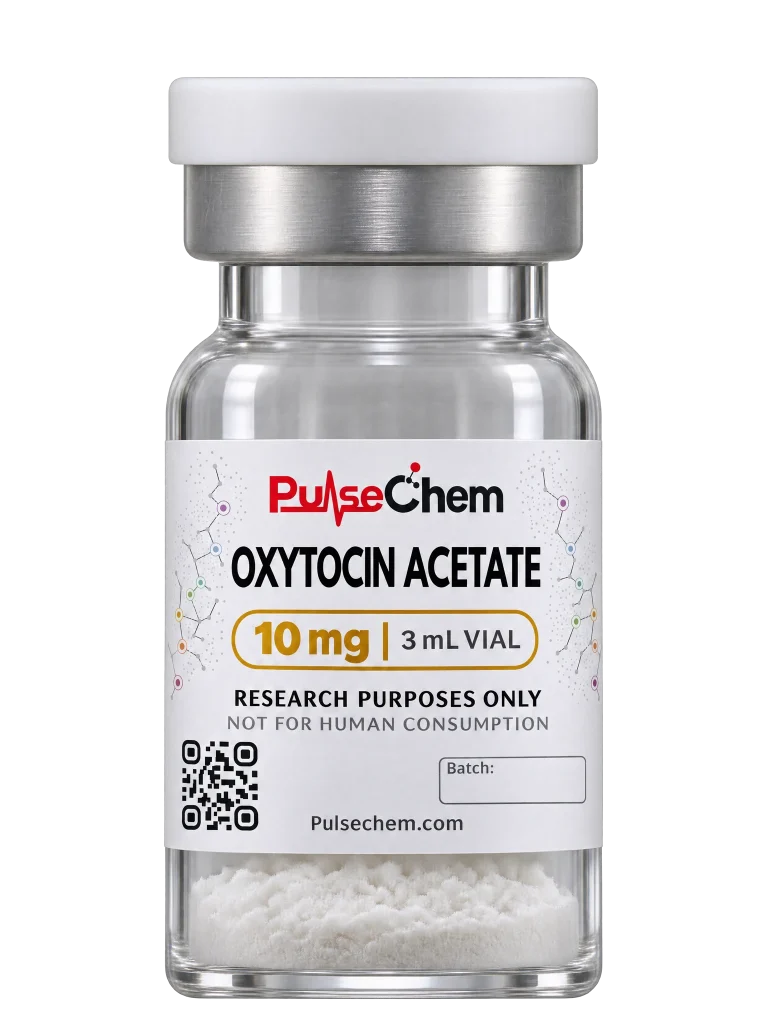
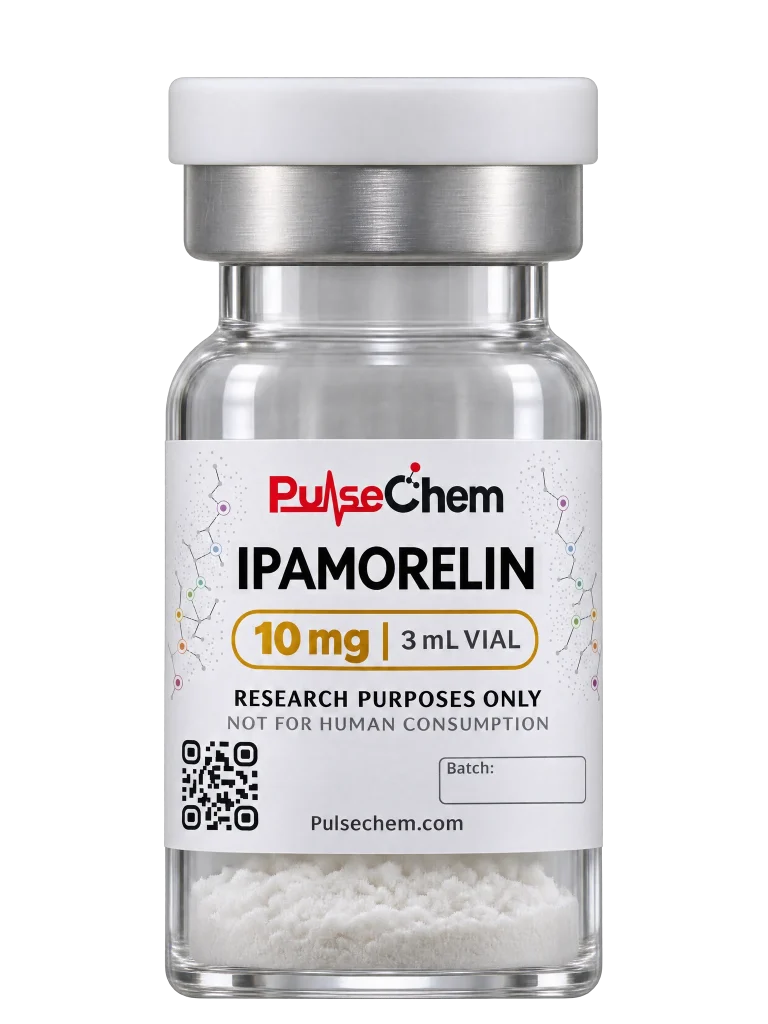
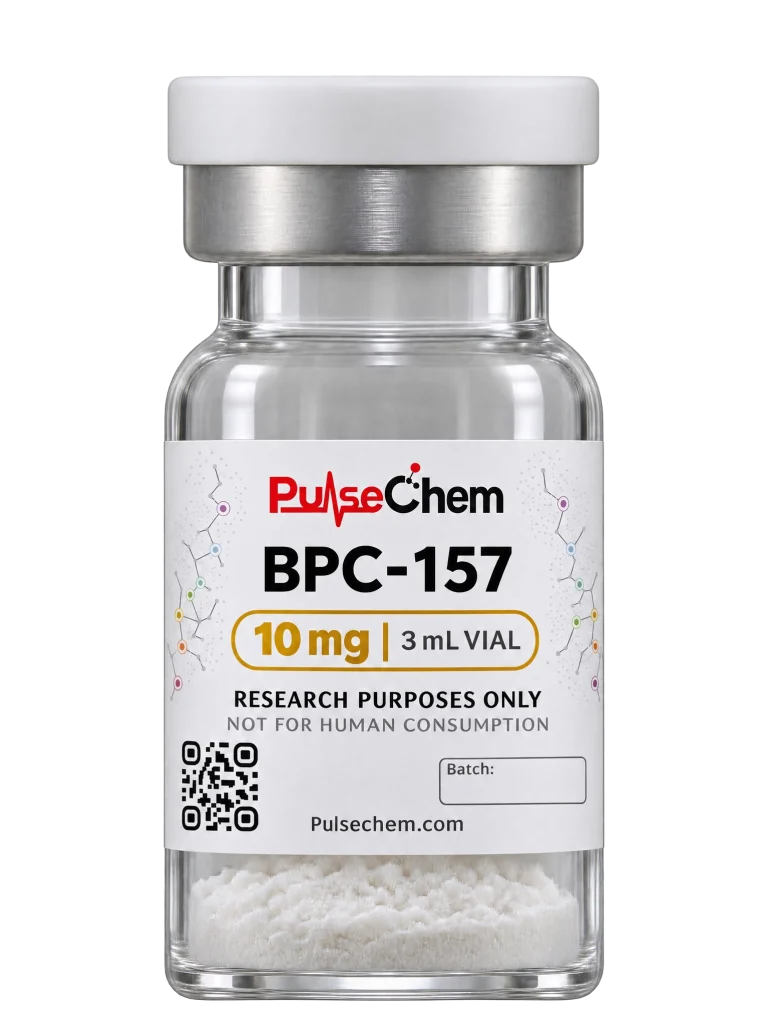
A research peptide is a chemical product. It is built one amino acid at a time, cleaved from its support, purified and dried. Knowing that route makes a certificate of analysis easier to read.
From solution to a solid support
The first peptides were made entirely in solution. Every coupling was carried out separately and every intermediate was isolated and purified. That is how Vincent du Vigneaud made oxytocin in the mid-1950s; in 1955 the Nobel committee called that the first synthesis of a polypeptide hormone. It was exacting work that could take years per peptide.
In 1963 Robert Bruce Merrifield published “Solid Phase Peptide Synthesis. I. The Synthesis of a Tetrapeptide” in the Journal of the American Chemical Society. In it he attached the growing chain to an insoluble polymer bead, the support or resin. In 1984 he received the Nobel Prize in Chemistry for it, with the citation “for his development of methodology for chemical synthesis on a solid matrix”. The press release of the Royal Swedish Academy of Sciences describes the core idea: because the chain is anchored to an insoluble support, unwanted material can simply be washed away after each step. Filtering and washing take the place of isolating every intermediate. The same press release names as a milestone that the enzyme ribonuclease was made in Merrifield’s laboratory in 1969.
The synthesis cycle
The chain grows from the C-terminal end, which is attached to the support. From there, the same sequence of steps repeats for each amino acid:
- Deprotection. The temporary protecting group on the amino acid added last comes off, freeing the amino group again.
- Coupling. The next amino acid is added in activated form and makes a peptide bond. Its side chains stay protected so they cannot react.
- Washing. Excess reagent and by-products are rinsed away; the peptide stays behind on the support.
Which protecting groups are used defines the route. The review by Behrendt, White and Offer (Journal of Peptide Science, 2016) states that Fmoc solid-phase peptide synthesis is today the method of choice. Fmoc stands for the fluorenylmethyloxycarbonyl group, which is removed from the amino group with a base; in that route the side chains carry tert-butyl groups, hence the name Fmoc/tBu. The older route is called Boc/Bzl, after the tert-butyloxycarbonyl and benzyl groups. The difference is not academic: the base needed in every Fmoc round also causes the main side reaction of this chemistry.
Where impurities come from
The same review calls aspartimide formation the most serious side reaction in Fmoc chemistry. It occurs when a sequence containing aspartic acid is exposed to strong base, and according to the authors it is a particular problem for long peptides and for sequences with several aspartic acid residues. BPC-157 is an example of such a sequence: it carries two aspartic acids side by side, at positions 10 and 11. The review also covers racemisation, the flipping of an amino acid into its mirror form.
Beyond that, chains arise in which one amino acid is missing, because a coupling did not run to completion, and chains that stop too early. All those by-products resemble the product itself. They show up as extra peaks in the chromatogram and as unexpected masses in the mass spectrum. See What does 99% purity mean? and How to read a mass spectrum.
Cleavage from the support
Once the chain is complete, the peptide is cleaved from the support and the permanent side-chain protecting groups are removed. In the Fmoc/tBu route that is done with an acid. What remains is a crude peptide: the intended product, plus the by-products of the synthesis.
Purification
The crude material goes through preparative reversed-phase HPLC. That is the same separation as the analytical measurement on a certificate of analysis, but on a larger scale and aimed at collecting material rather than measuring it. The fractions coming off the column are measured, and only the fractions that meet the specification are pooled. The pooled solution then goes into the freeze dryer. Why peptides are shipped dry, and what happens during freeze drying, is explained in Why lyophilize?
Counterions
A peptide with charged side chains comes out of purification as a salt. The counterion comes from the acids used during cleavage and in the column, usually trifluoroacetic acid: the powder is then a TFA salt. An extra step, ion exchange, replaces that counterion, for example with acetate. The catalogue holds a clear example: PubChem has a separate record for oxytocin acetate (CID 12004215) with a molecular weight of 1067.2, against 1007.2 for the peptide itself. That difference of about 60 is the acetate, and it is part of the weight of the powder. This is why the peptide content of a vial is always below 100%.
Long or modified peptides
The longer the chain, the more rounds and the more scope for incomplete couplings; the review names long peptides explicitly as a difficult case. Building blocks outside the standard set also take extra work. According to PubChem, ipamorelin contains 2-aminoisobutyric acid and D-2-naphthylalanine, two amino acids that do not occur in the genetic code. And a peptide can be modified after synthesis: PubChem describes CJC-1295 with DAC as a maleimido derivative of hGRF(1-29), that is, the same chain with an extra group attached.
Final checks
Two measurements close the process. Analytical HPLC gives the purity as the share of the main peak, and mass spectrometry confirms identity by comparing the measured mass with the calculated one. Both belong on the certificate, with the batch number and the date. Which checks PulseChem has carried out per batch is set out on the Laboratory standard page; how to judge a supplier on them is covered in Choosing a reliable supplier.
Further reading: What are peptides?, Why lyophilize?, What is a COA? and How to read a mass spectrum. The certificates for our batches are on Lab results.
Sources
Accessed in November 2026.
- The Nobel Prize in Chemistry 1955, Vincent du Vigneaud (Nobel Prize Outreach), with the citation “especially for the first synthesis of a polypeptide hormone”
- Merrifield R.B. (1963), Solid Phase Peptide Synthesis. I. The Synthesis of a Tetrapeptide, Journal of the American Chemical Society 85(14):2149-2154, doi 10.1021/ja00897a025
- The Nobel Prize in Chemistry 1984, press release (Nobel Prize Outreach), with the citation “for his development of methodology for chemical synthesis on a solid matrix” and the explanation of washing instead of isolating
- Behrendt R., White P., Offer J. (2016), Advances in Fmoc solid-phase peptide synthesis, Journal of Peptide Science 22(1):4-27 (PubMed), PMID 26785684, doi 10.1002/psc.2836: Fmoc SPPS as the method of choice, aspartimide formation and racemisation
- Oxytocin acetate (PubChem), CID 12004215, and Oxytocin, CID 439302: the weights 1067.2 and 1007.2
- Ipamorelin (PubChem), CID 9831659: Aib and D-2-naphthylalanine
- CJC-1295 (with DAC) (PubChem), CID 91971820: maleimido derivative of hGRF(1-29)
- BPC-157 (PubChem), CID 9941957: the sequence with Asp10 and Asp11
This article is background information on laboratory research. It is not medical advice or instructions for use. All products are for research use only.