CJC-1295 is not one single compound. The name is used for two related synthetic peptides derived from the first 29 amino acids of growth hormone-releasing hormone (GHRH). One form carries an extra building block that can bind to albumin, the Drug Affinity Complex or DAC. The other does not.
The starting point: GHRH(1-29)
GHRH is a hormone of 44 amino acids made by the body. Its first 29 amino acids also exist as a separate synthetic peptide. PubChem lists that chain under the name sermorelin, with the sequence Tyr-Ala-Asp-Ala-Ile-Phe-Thr-Asn-Ser-Tyr-Arg-Lys-Val-Leu-Gly-Gln-Leu-Ser-Ala-Arg-Lys-Leu-Leu-Gln-Asp-Ile-Met-Ser-Arg and an amide at the C-terminus. In one-letter code: YADAIFTNSYRKVLGQLSARKLLQDIMSR. According to that record, the sequence corresponds to the amino-terminal segment of the natural hormone.
Both forms of CJC-1295 are variants of that 29-residue chain. Put the sequences side by side and you can see exactly where they differ.
The form without DAC
The PubChem record with CID 56841945 describes a chain of 29 amino acids: H-Tyr-D-Ala-Asp-Ala-Ile-Phe-Thr-Gln-Ser-Tyr-Arg-Lys-Val-Leu-Ala-Gln-Leu-Ser-Ala-Arg-Lys-Leu-Leu-Gln-Asp-Ile-Leu-Ser-Arg-NH2. The molecular formula is C152H252N44O42 and the molecular mass 3367.9. This form is also sold as Mod GRF 1-29 or modified GRF (1-29).
Compared with GHRH(1-29), four building blocks have been replaced:
- Position 2: alanine is D-alanine, the mirror image of the same amino acid.
- Position 8: asparagine (Asn) is glutamine (Gln).
- Position 15: glycine (Gly) is alanine (Ala).
- Position 27: methionine (Met) is leucine (Leu).
Those four differences follow directly from the two sequences in PubChem. How to read such modifications is explained in How to read a peptide sequence.
The form with DAC
The record with CID 91971820 has the same chain plus an extra lysine at the end whose side chain carries a maleimidopropionyl group. PubChem describes the compound briefly as a maleimido derivative of hGRF(1-29). That maleimide group is the Drug Affinity Complex: it is designed to form a covalent bond with albumin, the most abundant protein in blood plasma. Formula C165H269N47O46, molecular mass 3647.2, CAS number 446262-90-4.
The technique comes from ConjuChem Inc. in Montreal. In 2005 researchers at that company (Jetté and colleagues, Endocrinology) described three maleimido derivatives of hGRF(1-29), designed to bind to the free thiol of cysteine 34 of serum albumin, and selected CJC-1295 from them. In a western blot of rat plasma the compound sat on the serum albumin band. In the 2006 clinical study by Teichman and colleagues the compound is called DAC:GRF; according to PubMed the first author worked at WinPharm Associates in California. The second clinical publication, by Ionescu and Frohman, comes from the University of Illinois at Chicago.
The two forms side by side
| Property | Without DAC | With DAC |
|---|---|---|
| PubChem CID | 56841945 | 91971820 |
| Chain | 29 amino acids | 29 amino acids plus lysine with side group |
| C-terminus | amide | amide |
| Molecular formula | C152H252N44O42 | C165H269N47O46 |
| Molecular mass | 3367.9 | 3647.2 |
| CAS number | 863288-34-0 and 446036-97-1 as synonyms on this record | 446262-90-4 |
Confusing names in the databases
The names run into each other in the sources, and that is not a detail. The record without DAC (CID 56841945) itself carries the synonyms CJC 1295 with DAC, DAC:GRF acetate and CJC-1295-no DAC acetate, so two names that contradict each other. The record that does carry the maleimide group (CID 91971820) is listed only as CJC 1295, CJC-1295, CJC1295 and GRF 1-29 (CJC1295), without the word DAC anywhere. The CAS numbers are mixed up too: 863288-34-0, which appears as a synonym on the record without DAC, is given by PubChem on the record with DAC as a deprecated number, with ChemIDplus as the source.
So the name on a vial cannot tell you which compound is in it. The mass decides: about 3368 without DAC and about 3647 with DAC, a difference of nearly 280. That gap is large enough to read off the certificate of analysis, and the measured mass should match the structure that is claimed.
What the research describes
There are two clinical pharmacology papers from 2006 in the Journal of Clinical Endocrinology and Metabolism, both in healthy adults.
- Teichman et al. (2006). Two randomised, placebo-controlled, double-blind, dose-escalating studies in which safety, tolerability, the pharmacokinetic profile and the concentrations of growth hormone and IGF-I were measured. The abstract gives an estimated half-life of 5.8 to 8.1 days and reports that concentrations of growth hormone and IGF-I rose. No serious adverse reactions were reported.
- Ionescu and Frohman (2006). With overnight sampling, the pulsatile pattern of growth hormone secretion persisted: the frequency and magnitude of the pulses were unaltered, while trough levels were higher.
That is what was measured and published. It says nothing about any application and is not a recommendation.
Status
CJC-1295 is not a medicine. Neither PubChem record lists an approved indication or an international nonproprietary name (INN). The record with DAC does refer to one registered study: NCT00267527, a phase 2 study by ConjuChem from 2005 and 2006, with the status terminated and no posted results. GHRH analogues can exist as approved medicines: tesamorelin was approved by the US FDA on 10 November 2010 under NDA 022505. That approval covers one specific finished product and says nothing about the research material on this page.
In the laboratory
Both forms are lyophilised powders. Store them as the label states: cold, dry and dark, and record the batch number in the lab notebook. The peptide has several basic residues (arginine and lysine), so in mass spectrometry it appears at several charge states instead of as a single peak. For identity, compare the measured mass with the calculated mass of the structure as supplied. For purity, look at the HPLC chromatogram.
These compounds are for laboratory research only (RUO). They have not been assessed for use in humans or animals.
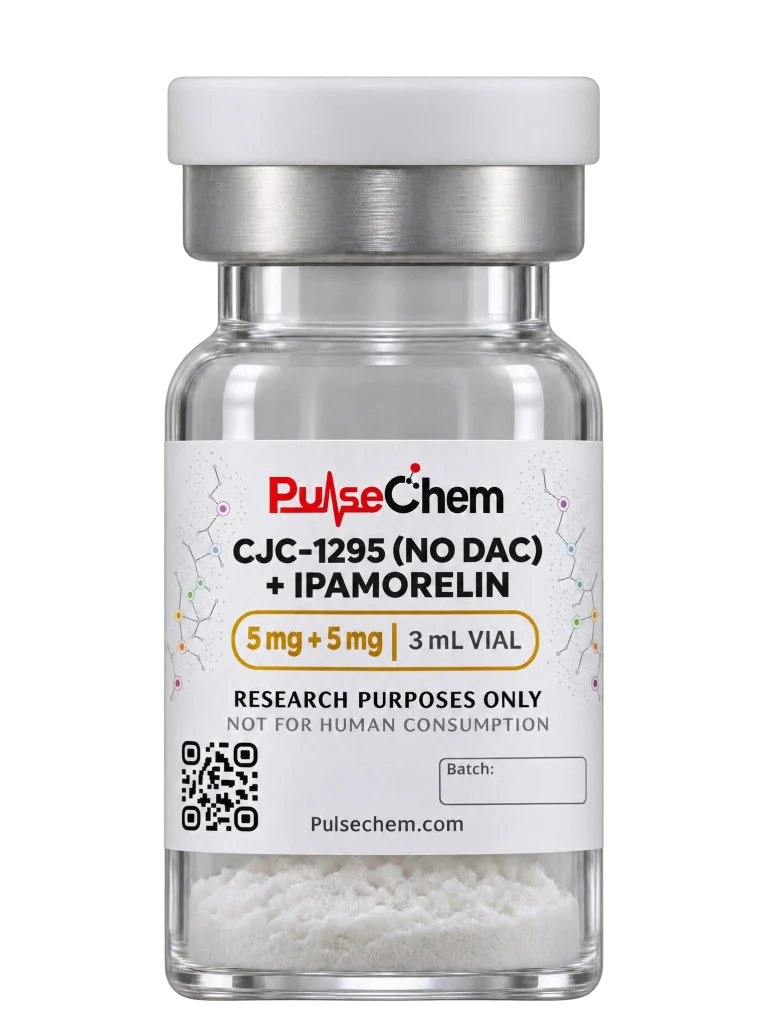
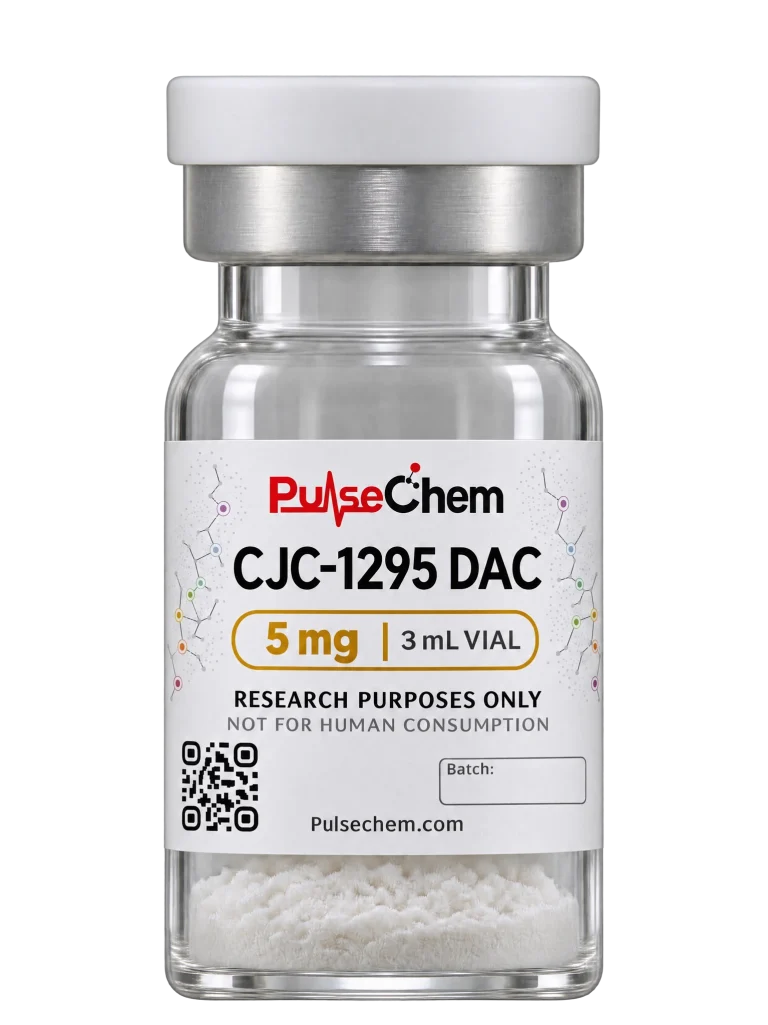
In the shop. PulseChem supplies CJC-1295 DAC and the blend CJC-1295 (no DAC) + Ipamorelin. Every batch comes with a certificate of analysis from an external laboratory; search by batch number on the Lab results page.
Further reading: What is ipamorelin?, How to read a peptide sequence and What is a COA?
Sources
Consulted in November 2026.
- CJC-1295 without DAC (PubChem, NCBI), CID 56841945: sequence, C152H252N44O42, molecular mass 3367.9, list of synonyms
- CJC-1295 with DAC (PubChem), CID 91971820: C165H269N47O46, molecular mass 3647.2, CAS 446262-90-4, described as a maleimido derivative of hGRF(1-29)
- Sermorelin (PubChem), CID 16132413: GHRH(1-29) amide, sequence and CAS 86168-78-7, with the note that GHRH has 44 amino acids
- Teichman SL, Neale A, Lawrence B, Gagnon C, Castaigne JP, Frohman LA. Prolonged stimulation of growth hormone (GH) and insulin-like growth factor I secretion by CJC-1295, a long-acting analog of GH-releasing hormone, in healthy adults (J Clin Endocrinol Metab 2006;91(3):799-805), PMID 16352683
- Ionescu M, Frohman LA. Pulsatile secretion of growth hormone (GH) persists during continuous stimulation by CJC-1295, a long-acting GH-releasing hormone analog (J Clin Endocrinol Metab 2006;91(12):4792-4797), PMID 17018654
- Approval letter for Egrifta (tesamorelin), NDA 022505, 10 November 2010 (FDA, Drugs@FDA); number and date also in the List of Approved NDAs for Biological Products That Were Deemed to be BLAs on March 23, 2020 (FDA)
- Jetté L et al. Human growth hormone-releasing factor (hGRF)1-29-albumin bioconjugates activate the GRF receptor on the anterior pituitary in rats: identification of CJC-1295 as a long-lasting GRF analog (Endocrinology 2005;146(7):3052-3058), PMID 15817669, ConjuChem Inc., Montreal
- A Study to Evaluate CJC 1295 in HIV Patients With Visceral Obesity (ClinicalTrials.gov), NCT00267527: phase 2, ConjuChem, status terminated
This article is background information on laboratory research. It is not medical advice or instructions for use. All products are for research use only.