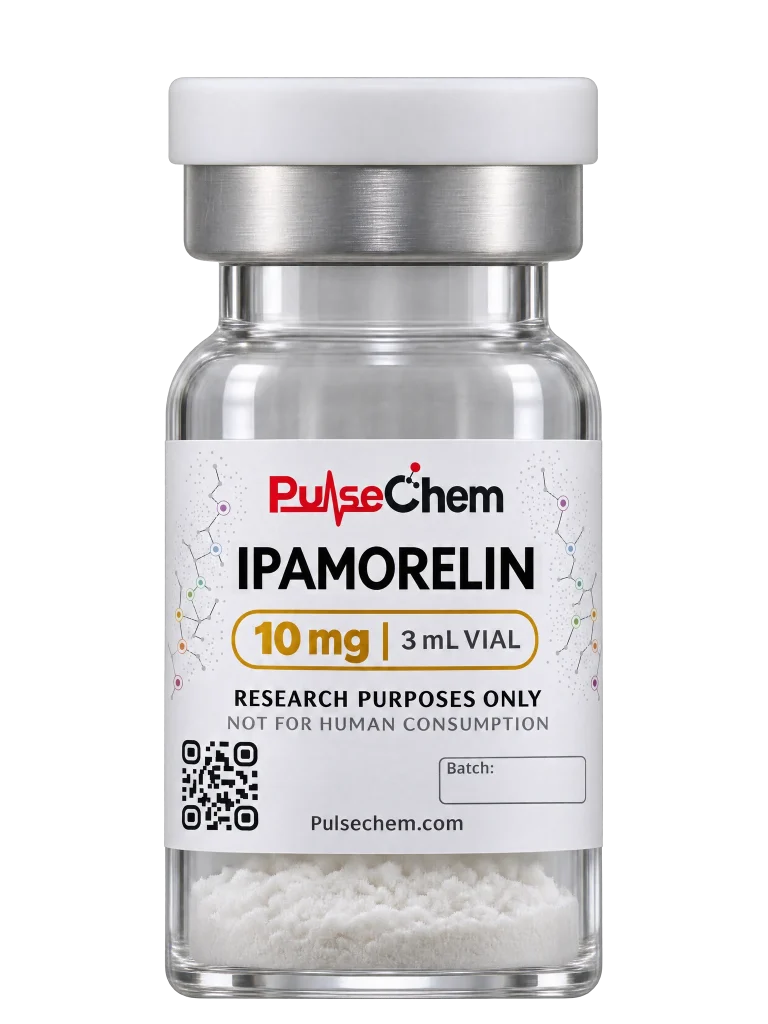
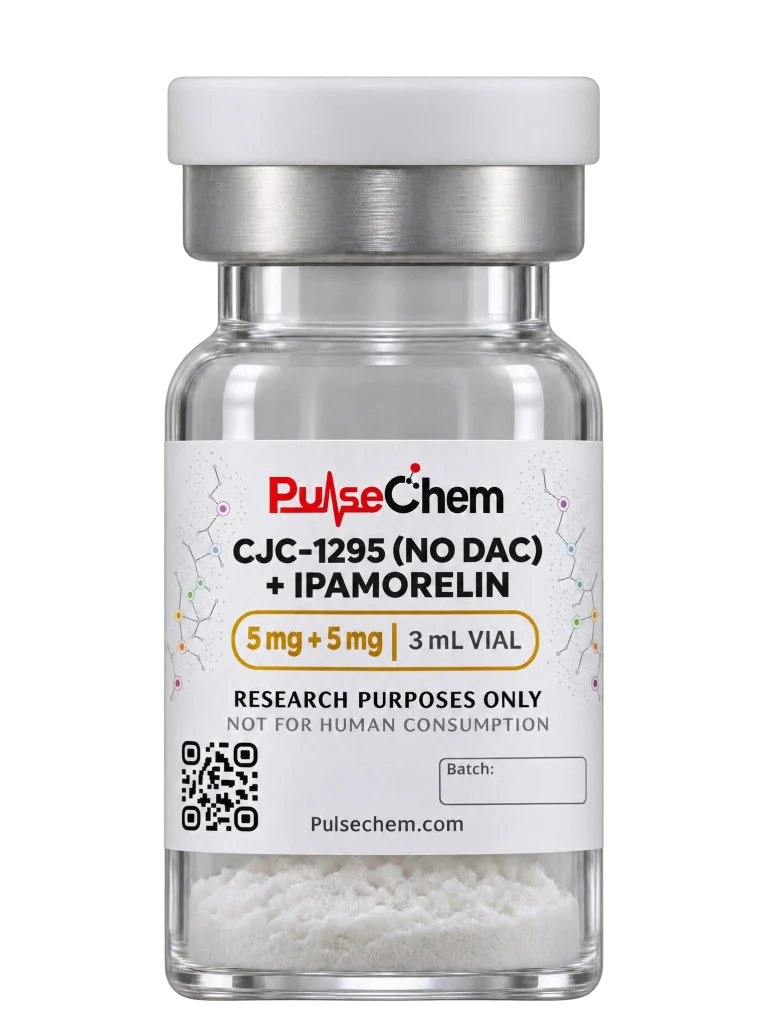
Ipamorelin is a synthetic peptide of five building blocks. In the literature it is described as a selective agonist of the ghrelin receptor, also known as the growth hormone secretagogue receptor (GHS-R). It was developed at Novo Nordisk and appears in the databases under the international nonproprietary name ipamorelin.
Structure
The chain is H-Aib-His-D-2Nal-D-Phe-Lys-NH2. Three of the five positions differ from the standard amino acids:
- Aib is 2-aminoisobutyric acid, an amino acid that does not occur in the genetic code.
- D-2Nal is D-2-naphthylalanine, carrying a naphthyl group in place of the phenyl group of phenylalanine.
- D-Phe is the mirror image of phenylalanine.
The C-terminus is an amide rather than a free acid. The molecular formula is C38H49N9O5, the molecular mass 711.9 and the CAS number 170851-70-4. PubChem lists the compound as CID 9831659, ChEMBL as CHEMBL58547 and DrugBank as DB12370.
Why databases show XHXFK
In one-letter code, ipamorelin reads XHXFK. The X is not an error: there is no one-letter code for Aib or for 2-naphthylalanine, so databases fill in an X. Only the histidine (H), the phenylalanine (F) and the lysine (K) keep their letter. That shows neatly why one-letter code says too little about synthetic peptides. There is more on this in How to read a peptide sequence.
Origin
The compound comes out of peptide research at Novo Nordisk; the synonym list still carries the internal code NNC 26-0161. Raun and colleagues described the development and pharmacology of the compound in November 1998 in the European Journal of Endocrinology, in a paper titled “Ipamorelin, the first selective growth hormone secretagogue”. The authors worked at Novo Nordisk in Denmark.
In that study, growth hormone release was measured in cultured rat pituitary cells, in anaesthetised rats and in conscious swine. The conclusion of the abstract is that ipamorelin is the first GHRP receptor agonist with a selectivity for growth hormone release similar to that of GHRH. The abstract states that ACTH and cortisol did not differ significantly from the levels seen after GHRH stimulation, even at amounts far above the effective amount for growth hormone release. That is a finding in animal models; the study says nothing about humans.
Ipamorelin was also the starting point for further chemistry. Ankersen and colleagues had already described a new series of peptides derived from ipamorelin in the Journal of Medicinal Chemistry in September 1998.
Status
Ipamorelin is not authorised as a medicine anywhere. PubChem gives phase 2 as the highest development phase reached and notes that the compound has been investigated in ileus, the stalling of bowel movement after surgery.
That study is registered on ClinicalTrials.gov as NCT00672074: a phase 2 study titled “Safety and Efficacy of Ipamorelin for Management of Post-Operative Ileus”, run by Helsinn Therapeutics (U.S.) Inc., with 117 participants undergoing bowel resection. The results were published in 2014 by Beck, Sweeney and McCarter in the International Journal of Colorectal Disease. The outcome was negative: there were no significant differences between ipamorelin and placebo in the key and secondary efficacy analyses, and the compound was well tolerated. The register also lists NCT01280344, another phase 2 study by Helsinn in patients after bowel resection, with 320 participants and the status completed, without posted results. The PubChem record links (as of 14 November 2026) to two entries in that register.
An outcome like that is worth stating. A compound that shows a clear effect in an animal experiment does not automatically repeat it in a clinical study.
In the laboratory
Ipamorelin is a lyophilised powder. Store it as the label states: cold, dry and dark, and record the batch number in the lab notebook.
Two things stand out when checking identity. The amide at the C-terminus makes the mass roughly 1 unit lower than the same chain with a free acid, and the two non-coded building blocks have to be counted in by hand; a calculator that only knows the twenty standard amino acids will return the wrong value. At 711.9 this peptide is small enough to appear in mass spectrometry mainly as a singly or doubly charged ion. Always compare the measured mass with the calculated mass on the certificate of analysis for your batch.
The material is for laboratory research only (RUO) and has not been assessed for use in humans or animals.
In the shop. PulseChem supplies Ipamorelin and the blend CJC-1295 (no DAC) + Ipamorelin. The certificate for your batch is on the product page and on the Lab results page.
Further reading: What is CJC-1295?, What are peptides?, What is a COA? and Choosing a reliable peptide supplier.
Sources
Consulted in November 2026.
- Ipamorelin (PubChem, NCBI), CID 9831659: sequence H-Aib-His-D-2Nal-D-Phe-Lys-NH2, one-letter code XHXFK, C38H49N9O5, molecular mass 711.9, CAS 170851-70-4, INN, phase 2 and the note on ileus
- Raun K, Hansen BS, Johansen NL, Thøgersen H, Madsen K, Ankersen M, Andersen PH. Ipamorelin, the first selective growth hormone secretagogue (Eur J Endocrinol 1998;139(5):552-561), PMID 9849822
- Ankersen M et al. A new series of highly potent growth hormone-releasing peptides derived from ipamorelin (J Med Chem 1998;41(19):3699-3704, 10 September 1998), PMID 9733495
- Safety and Efficacy of Ipamorelin for Management of Post-Operative Ileus (ClinicalTrials.gov), NCT00672074, phase 2, Helsinn Therapeutics (U.S.) Inc.
- Safety and Efficacy of Ipamorelin Compared to Placebo for the Recovery of Gastrointestinal Function (ClinicalTrials.gov), NCT01280344, phase 2, Helsinn Therapeutics (U.S.) Inc., 320 participants, completed, no results posted
- Beck DE, Sweeney WB, McCarter MD; Ipamorelin 201 Study Group. Prospective, randomized, controlled, proof-of-concept study of the ghrelin mimetic ipamorelin for the management of postoperative ileus in bowel resection patients (Int J Colorectal Dis 2014;29(12):1527-1534), PMID 25331030
This article is background information on laboratory research. It is not medical advice or instructions for use. All products are for research use only.