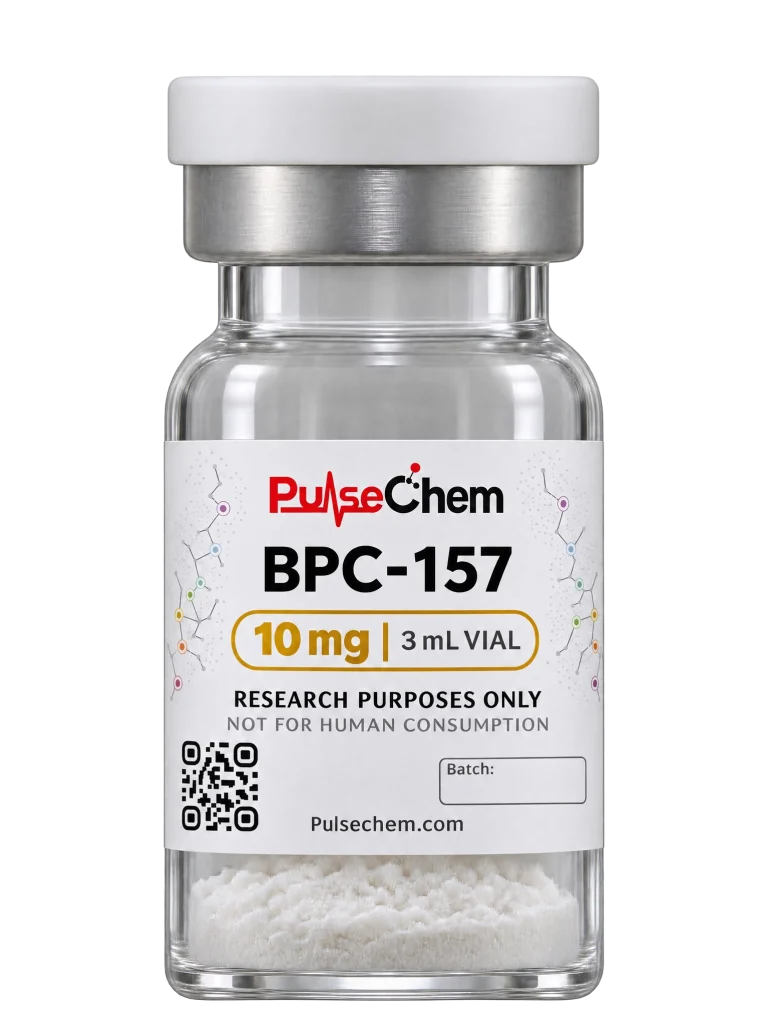
BPC-157 is a synthetic peptide of fifteen amino acids. It is described as a fragment of BPC, a substance from gastric juice that the researchers named body protection compound. BPC-157 is a research compound, not an authorized medicine.
Structure and identity
BPC-157 is a linear peptide with free ends: no acetyl group at the start and no amide at the end. These are the data from PubChem:
| Property | Value |
|---|---|
| Compound class | Synthetic peptide of 15 amino acids (pentadecapeptide) |
| Sequence, three-letter | H-Gly-Glu-Pro-Pro-Pro-Gly-Lys-Pro-Ala-Asp-Asp-Ala-Gly-Leu-Val-OH |
| Sequence, one-letter | GEPPPGKPADDAGLV |
| Molecular formula | C62H98N16O22 |
| Molecular weight (average) | 1419.5 g/mol |
| Monoisotopic mass | 1418.704 Da |
| CAS number | 137525-51-0 |
| Other names in PubChem | PL-14736, PLD-116, PL-10, Bepecin |
| PubChem CID | 9941957 |
You use the average molecular weight to convert a weighed mass into an amount of substance in moles. The monoisotopic mass is the mass of the molecule made up only of the most common isotopes; that is the value you see in a high-resolution mass spectrum. How to read the notation in the table is explained in How to read a peptide sequence.
Origin
The name comes from the work of Predrag Sikirić and colleagues. In European patent application EP 0432400, they describe a substance they call BPC and how they purified it from human and animal gastric juice. The international application was filed in September 1990. BPC stands for body protection compound. BPC-157 is a fifteen-amino-acid fragment of it that is made synthetically. PubChem describes it as a 15-amino-acid fragment of a gastric peptide, BPC.
The codes in the table have their own history. The title of a 2006 article by Sikirić and colleagues refers to trials in inflammatory bowel disease under the codes PL-10, PLD-116, and PL 14736, at the Croatian pharmaceutical company Pliva. Those codes appear as synonyms in PubChem, as does the name Bepecin.
What the research describes
Most of the literature on BPC-157 consists of studies in rodents and in vitro. In that work, BPC-157 has been studied in models of injury to the gastrointestinal tract and to tendons, ligaments, and muscles. Two reviews give an overview:
- Gwyer and colleagues (2019) discuss the research in models of injury to tendons, ligaments, and skeletal muscle. They write that most of the work was done in small rodent models and that efficacy in humans has not been confirmed.
- Józwiak and colleagues (2025) review the literature and the patents on BPC-157.
Data from research in humans are limited. Read this article as a description of what has been studied, not of what the compound does.
Research and regulatory status
BPC-157 is not an authorized medicine. In PubChem, the highest development phase, according to the ChEMBL database, is phase 1. The situation on November 14, 2026:
- Clinical research. The PubChem record refers to the registered study NCT02637284 (PCO-02), a phase 1 study of safety and pharmacokinetics in healthy volunteers. ClinicalTrials.gov lists that study with the status unknown and no posted results. Two newer studies were registered in 2026: NCT07437547, a phase 2 study that is recruiting, and NCT07803250, a phase 1 study that is not yet recruiting.
- European Union. Whether a substance counts as a medicinal product depends on how it is presented and what it does. How that works and how PulseChem handles it is explained on the Liability and research use page.
In the lab
For laboratory work, identity, purity, and storage are what count:
- Identity. Mass spectrometry compares the measured mass with the calculated one. For BPC-157, the monoisotopic mass is 1418.70. With electrospray ionization, you expect the [M+H]+ ion at around m/z 1419.71 and the doubly charged [M+2H]2+ ion at around m/z 710.36. How to read such a spectrum is covered in How to read a mass spectrum.
- Purity. Purity is determined by HPLC, as the share of the main peak in the chromatogram. That is not the same as the peptide content of the powder; see What 99% purity means.
- Storage. Keep lyophilized powder closed, cool, and dark, at the temperature on the label. Let a cold vial reach room temperature before you open it, so that no moisture condenses on the powder. More in Why lyophilize? and Storing peptides in the lab.
In the catalog, BPC-157 also comes in blends with TB-500, a different peptide with a different origin. In a mixture, each peptide has to be identifiable on its own on the certificate; that is the subject of Peptide blends in research. What a peptide is in general is explained in What are peptides?
BPC-157 at PulseChem. BPC-157 is available on its own and in the blends BPC-157 + TB-500, GHK-Cu + BPC-157 + TB-500, and GHK-Cu + BPC-157 + TB-500 + KPV. The certificate of analysis for each batch is on the product page and on Lab results, where you search by batch number. All products are for laboratory research only; see RUO explained.
Sources
Consulted in November 2026.
- BPC-157 (PubChem), CID 9941957: sequence, formula, mass, CAS number, synonyms, highest phase according to ChEMBL, and reference to NCT02637284
- EP 0432400 A2, Pharmacologically active substance BPC, the process for its preparation and its use in the therapy (Espacenet, European Patent Office) and US 5288708 (PubChem), from the same patent family, with the filing date of the international application
- Sikirić P. et al. (2006), Stable gastric pentadecapeptide BPC 157 in trials for inflammatory bowel disease (PL-10, PLD-116, PL 14736, Pliva, Croatia). Full and distended stomach, and vascular response, Inflammopharmacology 14:214-221 (PubMed), PMID 17186181
- Gwyer D., Wragg N.M., Wilson S.L. (2019), Gastric pentadecapeptide body protection compound BPC 157 and its role in accelerating musculoskeletal soft tissue healing, Cell Tissue Res 377:153-159 (PubMed), PMID 30915550
- Józwiak M. et al. (2025), Multifunctionality and Possible Medical Application of the BPC 157 Peptide: Literature and Patent Review, Pharmaceuticals 18:185 (PubMed Central), PMID 40005999
- PCO-02: Safety and Pharmacokinetics Trial (ClinicalTrials.gov), NCT02637284: phase 1, healthy volunteers, status unknown, no results
- NCT07437547 (phase 2, recruiting) and NCT07803250 (phase 1, not yet recruiting) (ClinicalTrials.gov)
- BPC-157 (ChEMBL, EMBL-EBI), CHEMBL4297358: highest phase 1
This article is background information on laboratory research. It is not medical advice or instructions for use. All products are for research use only.