What is BPC-157?
BPC-157 is a synthetic peptide of fifteen amino acids, described as a fragment of BPC, a substance from gastric juice. Its structure, origin, what the research describes, and its regulatory status.
Check the spelling or search for part of the name, such as BPC or GHK. Or choose below.
Popular searches
Go to
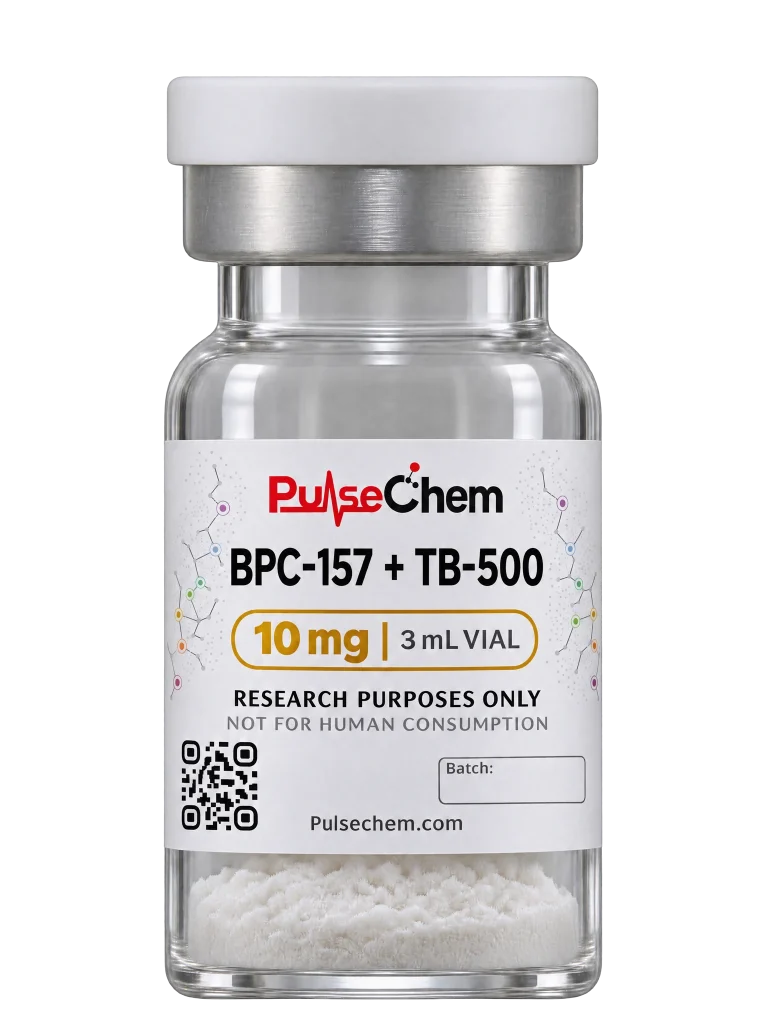
BPC-157 + TB-500 is a fixed combination of the peptides BPC-157 and TB-500 in one vial, with 10 or 20 mg in total. Buy BPC-157 + TB-500 for laboratory research from PulseChem: lyophilized powder, ≥99% purity by HPLC and a COA for every batch.
Price range: €77.45 through €127.95 incl. VAT
Volume discount
Research Use Only. For laboratory research use only (in vitro). Not for human or animal use. The products are not medicines, foods, or cosmetics. They are not intended to diagnose, treat, cure, or prevent any disease. The information on this website has not been evaluated by the EMA, the Romanian National Agency for Medicines and Medical Devices (ANMDMR), or the FDA. Read the RUO policy
This is how solutions are prepared in the lab.
Step 1 of 8: Disinfect
The stoppers of both vials are wiped with an alcohol swab.
For laboratory research use only (in vitro). Not for human or animal use.
Research area: Muscles Gut Heart and vessels
BPC-157 · 15 amino acids
Sequence: H-GEPPPGKPADDAGLV-OH
TB-500 · 7 amino acids
Sequence: Ac-LKKTETQ-OH
Structure from PubChem, CID 9941957, 62707662. Schematic in 3D, not a measured structure.
The batch number is on the vial label. You can find the certificate of analysis for that batch on the Lab results page or request it from us.
| Contents | 10 mg / 20 mg per vial |
|---|---|
| Purity | ≥99% (HPLC) |
| Intended use | For laboratory research use only (RUO) |
PulseChem has the BPC-157 TB-500 blend for sale in two strengths: 10 or 20 mg per vial, both peptides together. The two compounds are freeze-dried together into one lyophilized powder in a sealed glass vial. The label shows the total weight and a single batch number.
Prices start at €77.45. Anyone aged 18 or over who is buying for laboratory research can order as a guest or with an account, and confirms research use at checkout.
BPC-157 is a chain of 15 amino acids, described as a fragment of BPC from gastric juice (Sikirić and colleagues, University of Zagreb, patent application EP 0432400). According to PubChem and the FDA substance registry, TB-500 is the acetylated fragment 17 to 23 of thymosin beta-4. The two therefore have different origins, and neither is authorized as a medicine. How a blend is measured is explained in Peptide blends: reading the label and the COA
An external laboratory measures purity by HPLC (≥99%) and identity by mass spectrometry. In a mixture each component has its own peak: BPC-157 and TB-500 differ by more than 500 g/mol, so they are easy to tell apart in the spectrum. The batch number links the vial to its COA on Lab results.
Keep the vial closed, cool, dry and dark per label and COA; in a blend, the most sensitive component sets the conditions. Shipments go out from Europe with tracking, insulated, with a cold pack in warm weather. Orders placed and paid before 3 p.m. Central European time on a working day are dispatched that day; delivery takes 1–3 working days within Europe. EU only.
For laboratory research only, not for human or animal use.
BPC-157 + TB-500 is available from PulseChem in this web shop. Prices start at €77.45 including VAT for 10 mg, and BPC-157 + TB-500 is in stock. Pay before 3 p.m. Central European time on a working day and the order ships the same day; delivery takes 1–3 working days within Europe. Every batch has a COA.
A vial of BPC-157 + TB-500 holds both peptides together as a lyophilized powder, 10 or 20 mg in total. The label states that total weight and one batch number. The matching COA can be found by batch number on the Lab results page.
For BPC-157 + TB-500, an external laboratory measures purity by HPLC and identity by mass spectrometry for every batch. In a blend each peptide has its own peak, so BPC-157 and TB-500 can be identified separately. A batch is released at ≥99%, and its COA is on the Lab results page.
The difference is that BPC-157 + TB-500 combines both peptides in one vial, with one batch number and one COA. BPC-157 and TB-500 are also sold separately by PulseChem, each in its own 10 mg vial. Separate vials let you weigh and record each compound on its own; the blend stays as it was made.
BPC-157 is a synthetic peptide of fifteen amino acids, described as a fragment of BPC, a substance from gastric juice. Its structure, origin, what the research describes, and its regulatory status.
TB-500 is a trade name for a seven-amino-acid fragment of thymosin beta-4 with an acetyl group at the start. How it differs from the full protein, its structure, and its status.
A blend is one vial holding two or more compounds in a fixed ratio. How the label states the amount, how such a mixture is measured, and what belongs on its certificate.
This conversation is stored so we can answer your question. More in the privacy policy.