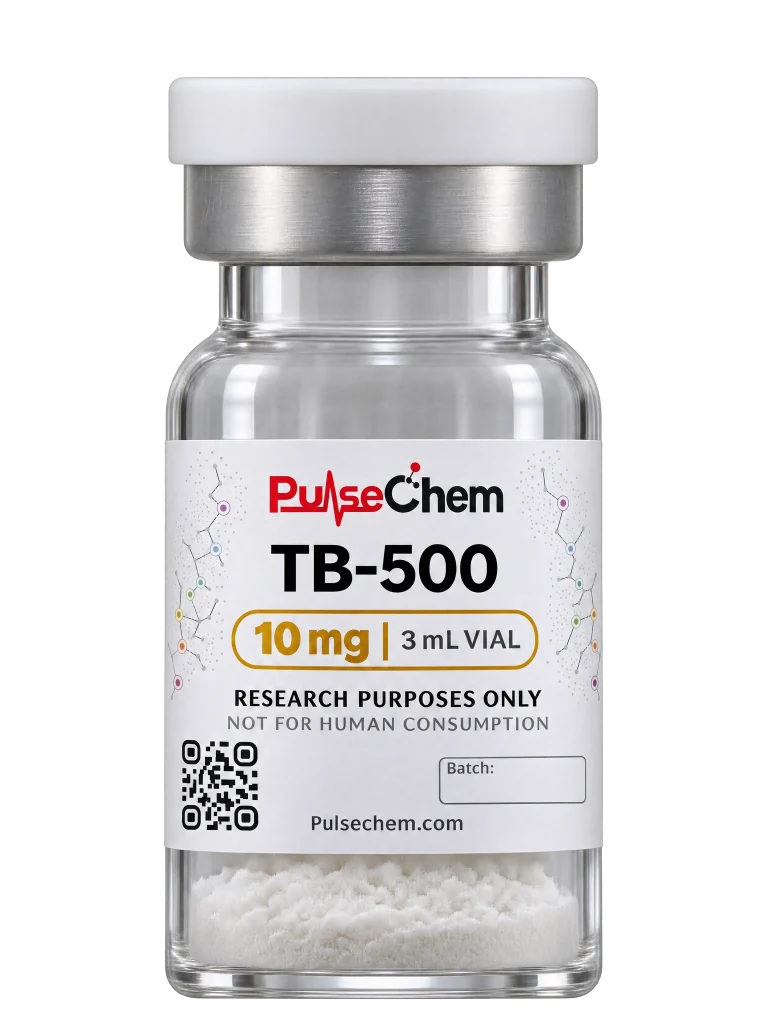
TB-500 is a trade name, not a systematic name. PubChem and the FDA’s substance registry link the name to a seven-amino-acid fragment of thymosin beta-4, with an acetyl group at the start. The full thymosin beta-4 is a different, much larger compound. The mass on the certificate of analysis shows which of the two is in a vial.
Fragment and full protein
TB-500 is derived from thymosin beta-4, but it is a different compound. Side by side:
| Property | TB-500 according to PubChem | Thymosin beta-4 |
|---|---|---|
| Length | 7 amino acids | 43 amino acids |
| Sequence | Ac-Leu-Lys-Lys-Thr-Glu-Thr-Gln-OH (Ac-LKKTETQ) | Ac-SDKPDMAEIEKFDKSKLKKTETQEKNPLPSKETIEQEKQAGES |
| Start of the chain | Acetylated leucine | Acetylated serine |
| Molecular formula | C38H68N10O14 | C212H350N56O78S |
| Molecular weight (average) | 889.0 g/mol | 4963 g/mol (calculated in PubChem); 4982 reported in 1981 |
| Monoisotopic mass | 888.49 Da | 4960.49 Da |
| CAS number | 885340-08-9 | 77642-24-1 (FDA substance registry) |
| Databases | PubChem CID 62707662 | PubChem CID 45382195, UniProt P62328 |
The fragment is exactly the stretch LKKTETQ found at positions 17 to 23 of thymosin beta-4, with an acetyl group on the leucine. The FDA’s substance registry describes TB-500 as the N-terminally acetylated 17-23 fragment of thymosin beta-4.
The difference in mass is large: about 889 versus about 4,960. That makes the mass on the certificate the quickest way to see which compound a batch contains. How to read a sequence with an acetyl group is explained in How to read a peptide sequence.
Searching PubChem for the name TB-500 brings you to this one record (CID 62707662). There is also a record for a variant that ends in glutamic acid instead of glutamine (Ac-LKKTETE-OH, CID 132558700); there, TB-500 appears only among the removed synonyms. That variant is about 1 dalton heavier: monoisotopic 889.48 versus 888.49. So compare the measured mass on the certificate closely with the calculated one.
Origin
Thymosin beta-4 was isolated from calf thymus. It is one of the peptides in thymosin fraction 5, a preparation from calf thymus. In 1981, Low, Hu, and Goldstein published the complete amino acid sequence in PNAS: 43 amino acids, with a molecular weight of 4982 and an isoelectric point of 5.1. In the PubChem record, the chain starts with an acetylated serine.
UniProt, the protein sequence database, lists the human form under P62328. There, the sequence is shown with a methionine in front (MSDKPD…), as the gene encodes it. The fragment called TB-500 is synthetic: it is built in a laboratory, not extracted from tissue.
What the research describes
Most of the research concerns the full thymosin beta-4. According to UniProt, it binds free actin monomers (G-actin) and holds on to them, which inhibits the formation of actin filaments. In 1991, Safer, Elzinga, and Nachmias showed that thymosin beta-4 is indistinguishable from Fx, a previously described peptide that sequesters actin. In a 2005 review, Goldstein, Hannappel, and Kleinman describe thymosin beta-4 as the main actin-sequestering molecule in cells and discuss research in models of tissue injury.
Those findings concern the 43-amino-acid protein. They do not automatically say anything about the seven-amino-acid fragment.
Status
- Not a medicine. TB-500 is not authorized as a medicine. No authorization as a medicine is known for thymosin beta-4 either.
- European Union. How the legal definition of a medicinal product works and how PulseChem handles it is explained on the Liability and research use page.
This status is as of November 14, 2026.
In the lab
- Identity. Mass spectrometry is the decisive test here. For the fragment (monoisotopic 888.49), electrospray ionization gives the [M+H]+ ion at around m/z 889.50 and [M+2H]2+ at around m/z 445.25. The full protein gives a series of multiply charged ions that convert back to about 4963. Explained in How to read a mass spectrum.
- Purity. HPLC gives the share of the main peak. The certificate should state both: the purity and the measured mass. See What is a COA?
- Storage. Keep the lyophilized powder closed, cool, and dark, at the temperature on the label. More in Why lyophilize? and Storing peptides in the lab.
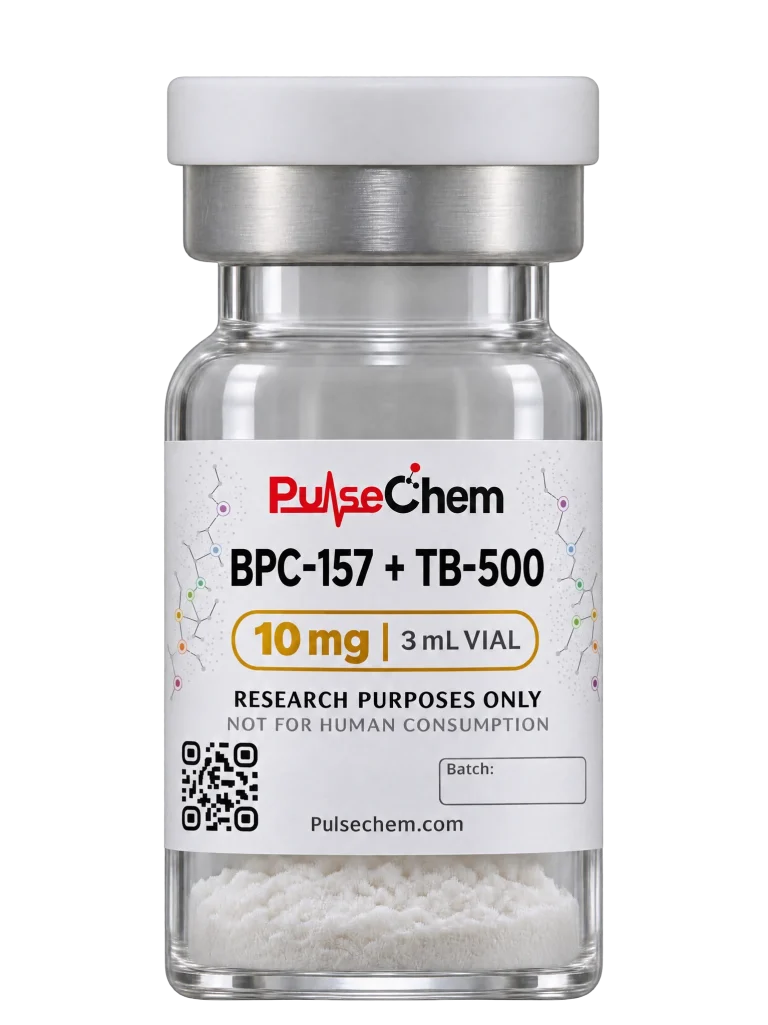
In the catalog, TB-500 also comes in blends with BPC-157. How such a mixture is analyzed is covered in Peptide blends in research.
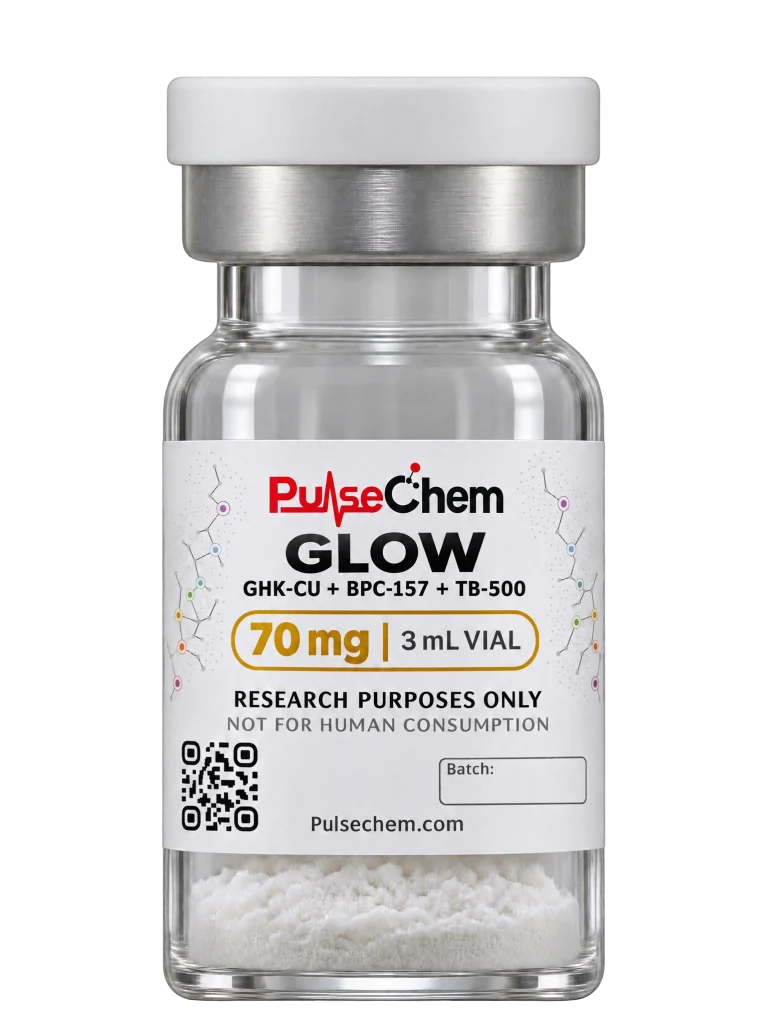
TB-500 at PulseChem. TB-500 is available on its own and in the blends BPC-157 + TB-500, GHK-Cu + BPC-157 + TB-500, and GHK-Cu + BPC-157 + TB-500 + KPV. Which compound a batch contains can be read from the mass on the certificate of analysis. You find it on the product page and on Lab results, where you search by batch number. For laboratory research only; see RUO explained.
Sources
Consulted in November 2026.
- TB-500 (Ac-LKKTETQ) (PubChem), CID 62707662: sequence, formula, mass, and CAS number; Ac-Leu-Lys-Lys-Thr-Glu-Thr-Glu-OH, CID 132558700, the glutamic acid variant, C38H67N9O15, monoisotopic 889.48, with TB-500 among the removed synonyms (consulted on 14 November 2026)
- Thymosin Beta 4 (PubChem), CID 45382195: sequence, formula, and calculated mass
- Thymosin beta-4, TMSB4X, human (UniProt), P62328
- TB-500, UNII QHK6Z47GTG and Thymosin beta-4, UNII 549LM7U24W (FDA Global Substance Registration System): description of the fragment and CAS numbers
- Low T.L., Hu S.K., Goldstein A.L. (1981), Complete amino acid sequence of bovine thymosin beta 4: a thymic hormone that induces terminal deoxynucleotidyl transferase activity in thymocyte populations, Proc Natl Acad Sci USA 78:1162-1166 (PubMed), PMID 6940133
- Safer D., Elzinga M., Nachmias V.T. (1991), Thymosin beta 4 and Fx, an actin-sequestering peptide, are indistinguishable, J Biol Chem 266:4029-4032 (PubMed), PMID 1999398
- Goldstein A.L., Hannappel E., Kleinman H.K. (2005), Thymosin beta4: actin-sequestering protein moonlights to repair injured tissues, Trends Mol Med 11:421-429 (PubMed), PMID 16099219
This article is background information on laboratory research. It is not medical advice or instructions for use. All products are for research use only.