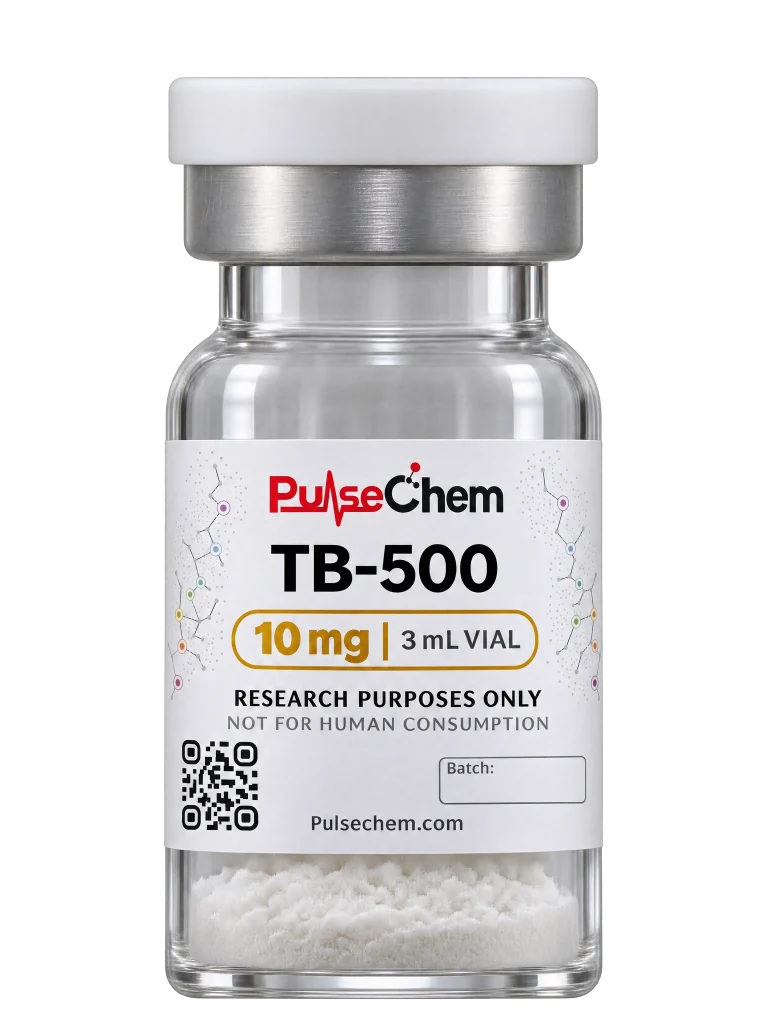
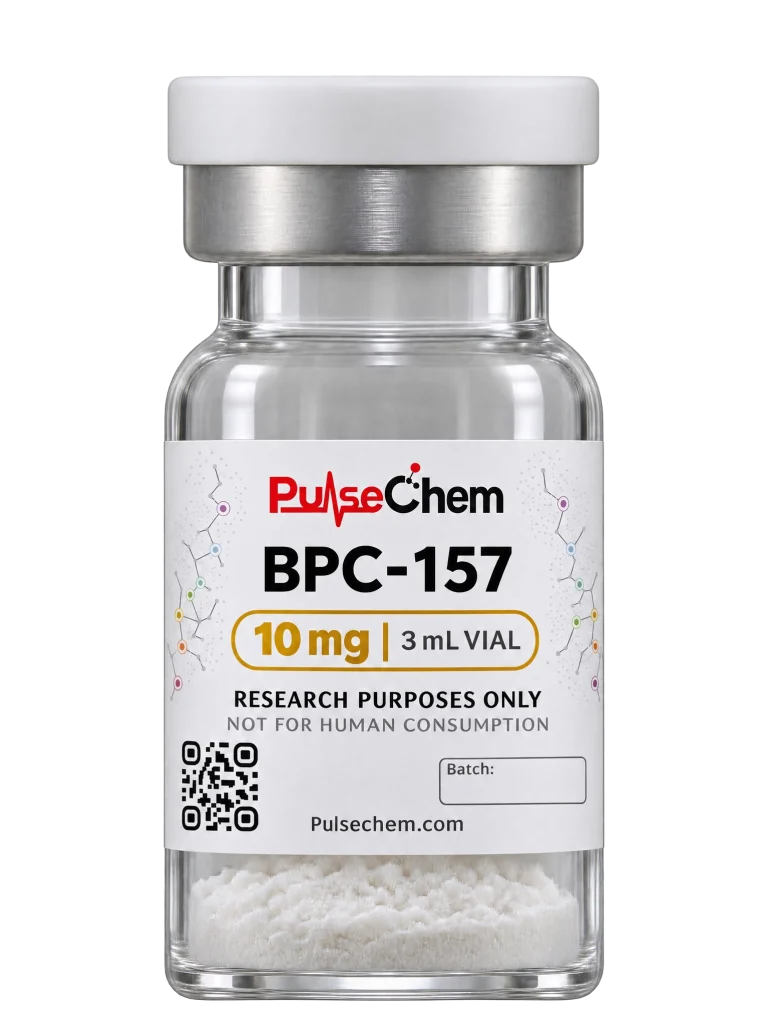
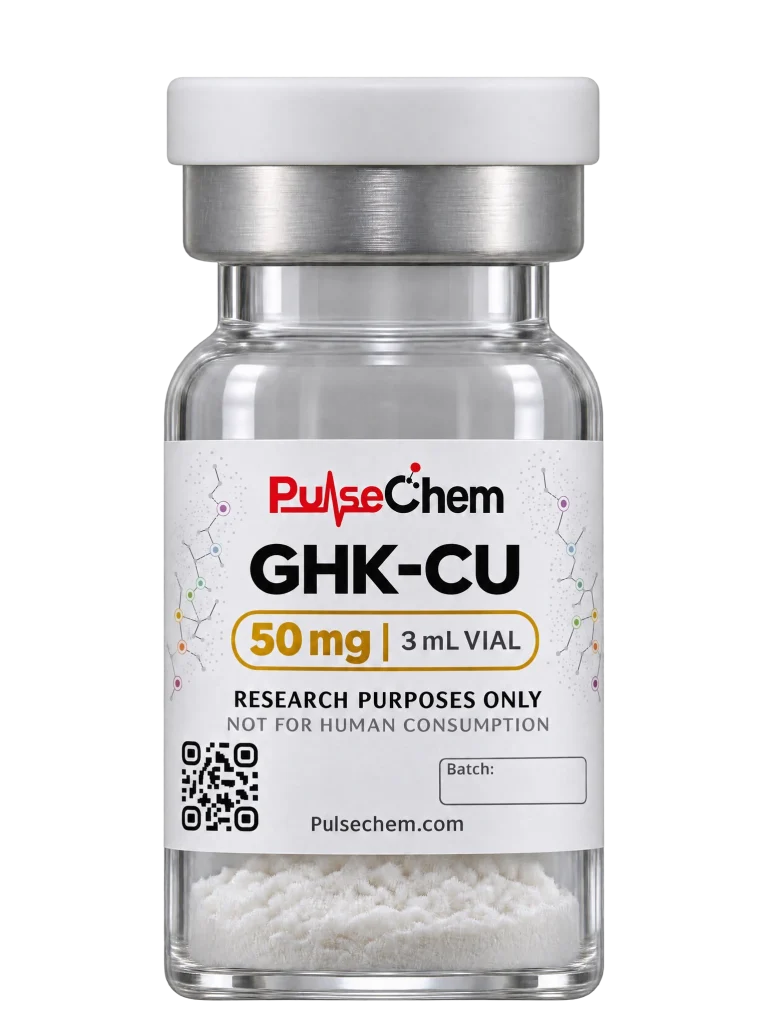
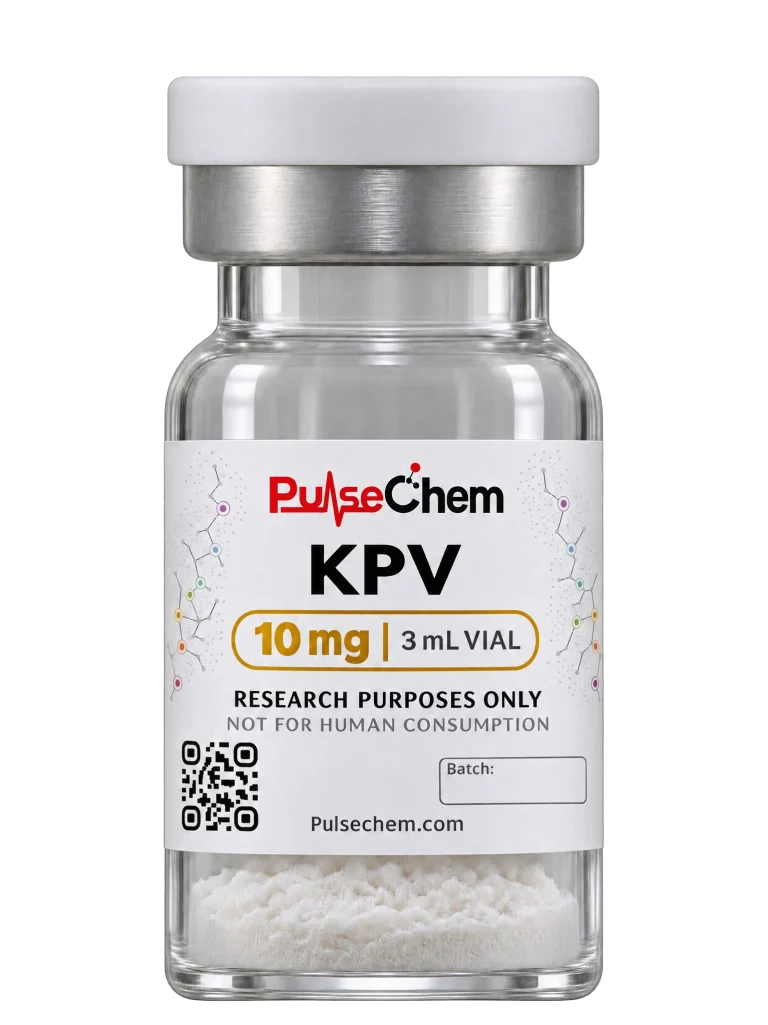
Some vials hold not one compound but two, three or four. A blend like that asks more of the label and of the certificate of analysis than a single peptide does, because every component has to be demonstrable on its own.
What a blend is
A blend is a mixture of two or more compounds lyophilised together in one vial, in a ratio set by the manufacturer. You cannot change that ratio yourself: what is in the vial is in the vial. This catalogue holds four blends, with the amount as the shop states it:
| Blend | Components | Amount on the label |
|---|---|---|
| BPC-157 + TB-500 | 2 | 10 mg or 20 mg |
| CJC-1295 (no DAC) + Ipamorelin | 2 | 5 mg + 5 mg |
| GHK-Cu + BPC-157 + TB-500 (Glow) | 3 | 70 mg |
| GHK-Cu + BPC-157 + TB-500 + KPV (Klow) | 4 | 80 mg |
For CJC-1295 (no DAC) + Ipamorelin the split is in the strength itself: 5 mg plus 5 mg. For the other three the label carries a single total weight. How much of each component that total contains is not stated on the product page; ask the supplier for the split or read it from the certificate for the batch. A total of 70 mg says nothing yet about the ratio between three compounds.
One vial or separate vials
A blend and separate vials differ mainly in freedom. A blend fixes the ratio and saves handling steps; separate vials let you weigh and record each compound on its own. Which form fits depends on your design. If you want to judge one compound, one compound per vial is clearer.
This article says nothing about combined or synergistic action of compounds in a mixture. That is not modesty but a fact: such statements belong to research carried out and published per combination, and they do not belong to a product that is strictly for laboratory research (RUO explained).
How a blend is measured
For a single peptide, purity is the share of the main peak in the chromatogram. In a mixture there is more than one main peak, and then the arithmetic changes:
- Separation. The HPLC method has to separate the components so that each one has its own peak. If two peaks overlap, neither figure can be trusted.
- Purity per component. A purity percentage belongs to one compound. So a blend COA carries several percentages, each with the name of its component, and not one figure for the vial.
- Identity per component. Mass spectrometry gives each component its own mass. The four compounds in the largest blend sit conveniently far apart: according to PubChem, GHK-Cu has a molecular weight of 402.9, KPV 342.4, TB-500 889.0 and BPC-157 1419.5. In the other blend, CJC-1295 without DAC (3367.9) and ipamorelin (711.9) stand just as clearly apart. How to read such a spectrum is explained in How to read a mass spectrum.
- Content per component. A content assay compares the signal of a compound with that of a reference standard of known composition. So each component needs a standard of its own. That is why the split inside a blend is harder to support than the amount in a single-compound vial.
Reading a blend COA
Work through a certificate for a mixture in this order:
- Are all components listed? Four compounds on the label means four lines on the certificate.
- Does each component have its own mass and purity? One percentage for the whole vial is not enough.
- Does the batch number match? A blended vial has one batch number, and it must equal the number on the label.
- Is the total amount stated, and the split? If not, ask for it.
- Is the chromatogram included? Only there can you see whether the peaks are really separated.
- Is the method stated? Column, wavelength and gradient, so the measurement can be followed.
The general explanation of certificates is in What is a COA?, and the difference between purity and peptide content in What does 99% purity mean?
Stability
In a mixture, each component brings its own chemistry. GHK-Cu is a complex with a copper ion, TB-500 is an acetylated seven-residue fragment and BPC-157 a chain of fifteen; those three do not degrade in the same way. So the practical rule is simple: follow the label on the vial, and assume the most sensitive component sets the pace. Which reactions are involved is set out in Storing peptides in the lab.
The components have articles of their own: BPC-157, TB-500, GHK-Cu, KPV, CJC-1295 and Ipamorelin.
Blends at PulseChem: BPC-157 + TB-500, CJC-1295 (no DAC) + Ipamorelin, GHK-Cu + BPC-157 + TB-500 and GHK-Cu + BPC-157 + TB-500 + KPV. The certificate for each batch is on the product page and on Lab results.
Sources
Accessed in November 2026.
- Prezatide copper (GHK-Cu) (PubChem), CID 71587328: molecular weight 402.92
- KPV (Lys-Pro-Val) (PubChem), CID 125672, listed there as MSH (11-13): molecular weight 342.43
- TB-500 (Ac-LKKTETQ) (PubChem), CID 62707662: molecular weight 889.0
- BPC-157 (PubChem), CID 9941957: molecular weight 1419.5
- CJC-1295 without DAC (PubChem), CID 56841945: molecular weight 3367.9
- Ipamorelin (PubChem), CID 9831659: molecular weight 711.9
- The amounts and the composition of the blends: the PulseChem product pages and labels, accessed on 14 November 2026
This article is background information on laboratory research. It is not medical advice or instructions for use. All products are for research use only.