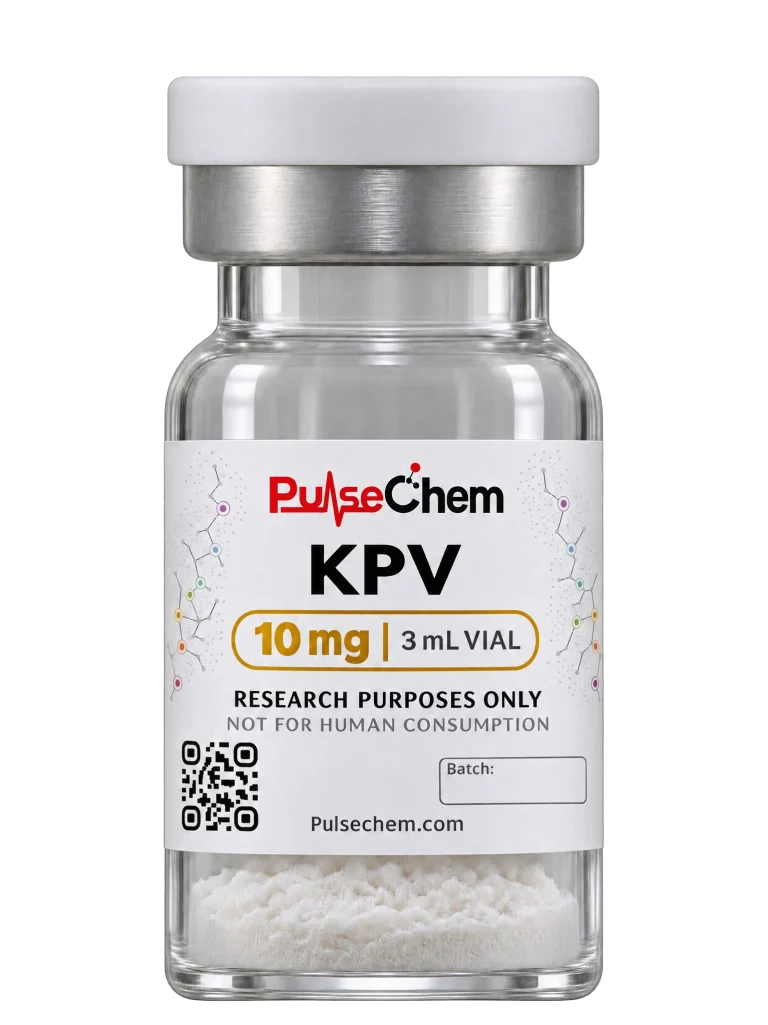
KPV consists of three amino acids: lysine, proline and valine. The name is simply the one-letter code of those three, K, P and V. The tripeptide is the end of a longer hormone, alpha-MSH, and it has been studied as a compound in its own right in cell and animal studies.
Structure
The sequence is H-Lys-Pro-Val-OH: a free amino group at the start, a free acid at the end. PubChem titles the record MSH (11-13), and the description from MeSH notes that the CAS number refers to the form in which all three amino acids are in the L form.
| Property | Value |
|---|---|
| Compound class | Tripeptide |
| Sequence | H-Lys-Pro-Val-OH (KPV) |
| Molecular formula | C16H30N4O4 |
| Molecular weight (average) | 342.43 g/mol |
| Monoisotopic mass | 342.227 Da |
| CAS number | 67727-97-3 |
| PubChem CID | 125672 |
A name is not an identity
If you search PubChem for the name KPV, you do not get this peptide. You end up at CID 13294447, 2-oxo-5-phenylpentanoic acid, with the formula C11H12O3 and a molecular weight of 192.21. That is not a peptide; the three letters just happen to appear in its list of synonyms too. Search for Lys-Pro-Val and you do find CID 125672.
With only three letters, a clash like this is not surprising. It shows why you identify a compound by its sequence and CAS number, not by a short name. How to read and check a sequence is covered in How to read a peptide sequence.
Origin
Alpha-MSH (alpha-melanocyte-stimulating hormone) is a peptide hormone of thirteen amino acids. In PubChem (CID 16133793) the sequence is Ac-Ser-Tyr-Ser-Met-Glu-His-Phe-Arg-Trp-Gly-Lys-Pro-Val-NH2, or Ac-SYSMEHFRWGKPV-NH2 for short. According to MeSH, it is formed from the first thirteen amino acids of the hormone ACTH, which first receive an amide at the end and then an acetyl group at the start. ChEBI describes alpha-MSH as an endogenous melanocortin receptor agonist.
KPV is the stretch 11 to 13: the last three amino acids. There is one difference from that stretch in the hormone. In alpha-MSH the chain ends in an amide (valinamide); KPV as described here has a free acid at the end. PubChem therefore also lists it as alpha-MSH (11-13) (free acid). Another synonym in the same record is ACTH-(11-13).
What the research describes
One of the published studies is that of Dalmasso and colleagues (2008) in Gastroenterology. They investigated whether KPV is taken up by intestinal cells through PepT1. According to UniProt, PepT1 is a transport protein that carries peptides of two to four amino acids across the cell membrane and is mainly responsible for absorbing di- and tripeptides from the small intestine. The authors worked with cultured intestinal cells and with mouse models of intestinal inflammation (colitis).
This article mentions that research because it has been published, not as a property of the product, and gives no results. These are cell and animal models; no use is described and no effect is promised.
Status
KPV is not a medicine. The PubChem record for KPV contains no information on a medicine, an authorisation or a clinical trial (checked on 14 November 2026). The material sold by PulseChem is intended for laboratory research only and not for humans or animals. What that means is explained in RUO explained.
In the lab
- Mass spectrometry. With a monoisotopic mass of 342.23, KPV appears low in the spectrum: with one proton at around m/z 343.2. That is far below the peaks of larger peptides. Note that a tripeptide with the same three amino acids in a different order, such as Val-Pro-Lys, has exactly the same formula and therefore the same mass. Mass alone does not prove the order; for that you look at the retention time in HPLC or at fragments in MS/MS. How to read a spectrum is covered in How to read a mass spectrum.
- Salt and counterion. PubChem’s synonyms also include an acetate salt (H-Lys-Pro-Val-OH acetate salt). A counterion counts towards the weight of the powder, but not towards the HPLC purity. The difference is explained in What does 99% purity mean? and in the glossary.
- In a mixture. KPV is also one of the four components of a blend with GHK-Cu, BPC-157 and TB-500. More on such mixtures in Peptide blends in research.
- Storage. Keep the lyophilised powder closed, cool, dry and dark, at the temperature on the label.
In the shop. PulseChem supplies KPV in 10 mg and the blend GHK-Cu + BPC-157 + TB-500 + KPV, for laboratory research only. You can look up the certificate for your batch by batch number on Lab results.
Read more: What is GHK-Cu?, Peptide blends in research and What are peptides?
Sources
Consulted in November 2026.
- Msh (11-13) (PubChem, NCBI), CID 125672: sequence H-Lys-Pro-Val-OH, C16H30N4O4, molecular weight 342.43, CAS 67727-97-3, synonyms and description from MeSH
- 5-Phenyl-2-keto-valeric acid (PubChem, NCBI), CID 13294447: the compound the name KPV returns in PubChem
- Alpha-msh (PubChem, NCBI), CID 16133793: sequence Ac-SYSMEHFRWGKPV-NH2 and descriptions from MeSH and ChEBI
- Solute carrier family 15 member 1 (SLC15A1, human) (UniProt), P46059: PepT1, transport of oligopeptides of two to four amino acids and absorption of di- and tripeptides from the small intestine
- Dalmasso G et al. PepT1-mediated tripeptide KPV uptake reduces intestinal inflammation (Gastroenterology 2008;134(1):166-178), PMID 18061177, doi 10.1053/j.gastro.2007.10.026
This article is background information on laboratory research. It is not medical advice or instructions for use. All products are for research use only.