GHK is the tripeptide glycyl-histidyl-lysine: three amino acids long. GHK-Cu is the complex of that peptide with a copper(II) ion, also known as copper peptide. It was described in human serum in the 1970s and has since been studied in cell culture, among other systems.
Structure: peptide and complex
GHK-Cu involves two substances, each with its own record, its own formula, and its own CAS number. According to PubChem:
| Property | GHK | GHK-Cu |
|---|---|---|
| What it is | Tripeptide | Complex of GHK with copper(II) |
| Sequence | H-Gly-His-Lys-OH | H-Gly-His-Lys-OH with Cu2+ |
| Molecular formula | C14H24N6O4 | C14H23CuN6O4+ |
| Molecular weight (average) | 340.38 g/mol | 402.92 g/mol |
| Monoisotopic mass | 340.186 Da | 402.108 Da |
| CAS number | 49557-75-7 | 89030-95-5 |
| Name in PubChem | glycyl-L-histidyl-L-lysine | Prezatide copper |
| PubChem CID | 73587 | 71587328 |
Why do the masses differ? The complex contains one copper atom and one hydrogen atom fewer than the free peptide. You can check it: 340.38 minus 1.01 plus 63.55 for copper gives 402.92. In the PubChem record, the complex carries a net charge of plus one.
For a certificate of analysis, this means: check which mass is stated. A laboratory may report the mass of the peptide GHK, that of the complex, or that of a salt form. PubChem also lists acetate and TFA salts for the complex; a counterion changes the weight of the powder again. All three are correct, as long as the certificate says what was measured.
Origin
In 1973, Pickart and Thaler described in Nature New Biology a tripeptide in human serum that, in their experiments, affected cultured liver cells. In 1977, Schlesinger, Pickart, and Thaler established that it was glycyl-histidyl-lysine. In 1979, Pickart, Thaler, and Millard described how transition metals affected the yield when the peptide was isolated from plasma.
PubChem notes that GHK is found in human plasma. The link with copper is in the name: GHK-Cu.
What the research describes
An early study is the one by Maquart and colleagues from 1988. They described increased collagen synthesis in cultures of fibroblasts, the cells that make collagen, after the GHK-Cu complex was added. These are measurements in cell culture.
In a 2015 review, Pickart, Vasquez-Soltero, and Margolina give an overview of laboratory research on GHK, including gene expression data. Pickart is an author of the 1973 publication, of the 1988 study, and of this review. That is worth knowing when you weigh the literature.
Regulatory categories
GHK-Cu appears under several names, each from a different system:
- International Nonproprietary Name (INN). The INN prezatide copper acetate belongs to an acetate form with two GHK molecules on one copper ion (C32H54CuN12O12, CAS 130120-57-9). ChemIDplus and the FDA’s substance registry (UNII A3LEI4P1NB) list the substance under that name. In PubChem (CID 9876021) the same substance also carries the name bis(tripeptide-1) copper acetate. PubChem lists the complex of one GHK with one copper ion as prezatide copper.
- Cosmetic ingredient name (INCI). PubChem gives COPPER TRIPEPTIDE-1 as the INCI name of the complex and TRIPEPTIDE-1 as the INCI name of the peptide. Under COPPER TRIPEPTIDE-1 it also appears in CosIng, the European Commission’s database of cosmetic ingredients.
- Medicine. PubChem and DrugBank describe the complex as an ingredient of cosmetic products and as a compound under investigation. They mention no authorization as a medicine.
A listing in CosIng does not turn research material into a cosmetic product. The European Commission itself states that the ingredients in CosIng do not form a positive list of substances permitted in cosmetics, and that only Regulation (EC) No 1223/2009 has legal value. Whether something is a cosmetic product depends, under Article 2 of that regulation, on the product and the purpose for which it is intended. GHK-Cu powder from PulseChem is intended for laboratory research and is not offered as a cosmetic product or a medicine. More on this on the Liability and research use page.
In the lab
- Identity. Use mass spectrometry to check that the measured mass matches what the certificate says it measured: the free peptide (monoisotopic 340.19, as [M+H]+ at around m/z 341.19) or the complex (402.11). See How to read a mass spectrum.
- Purity. HPLC gives the share of the main peak; see What is a COA?
- Storage. Keep the lyophilized powder closed, cool, and dark, at the temperature on the label. More in Storing peptides in the lab.
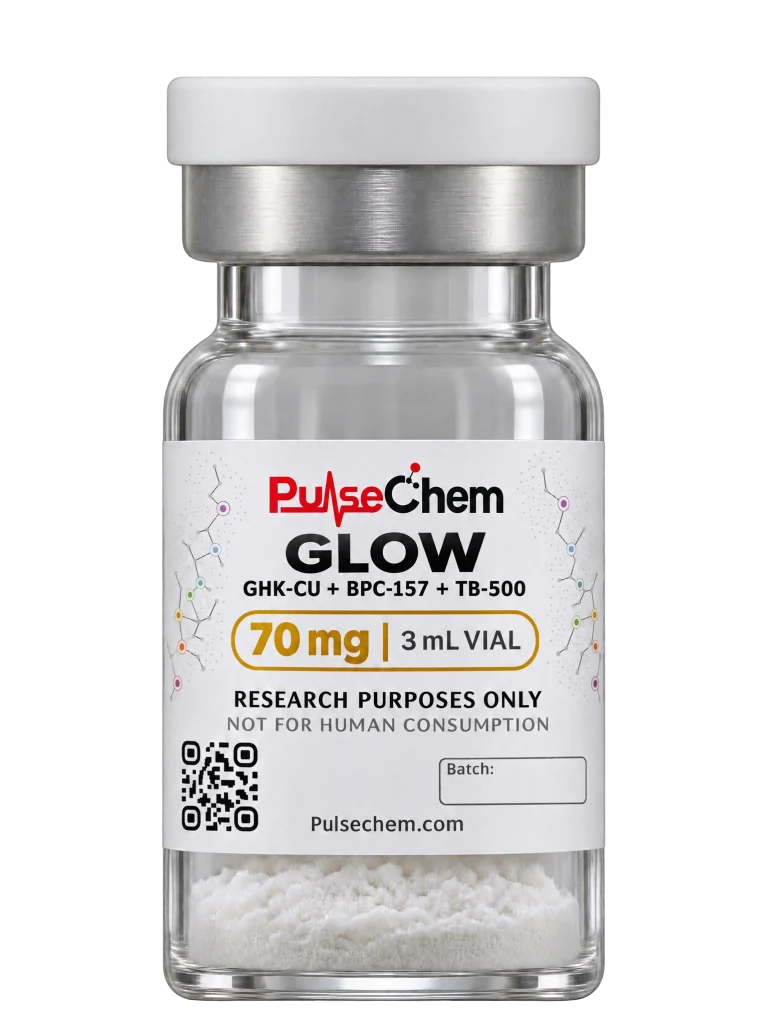
GHK-Cu also comes in blends with BPC-157, TB-500, and KPV; how such a mixture is analyzed is covered in Peptide blends in research. The basics of tripeptides are in What are peptides?
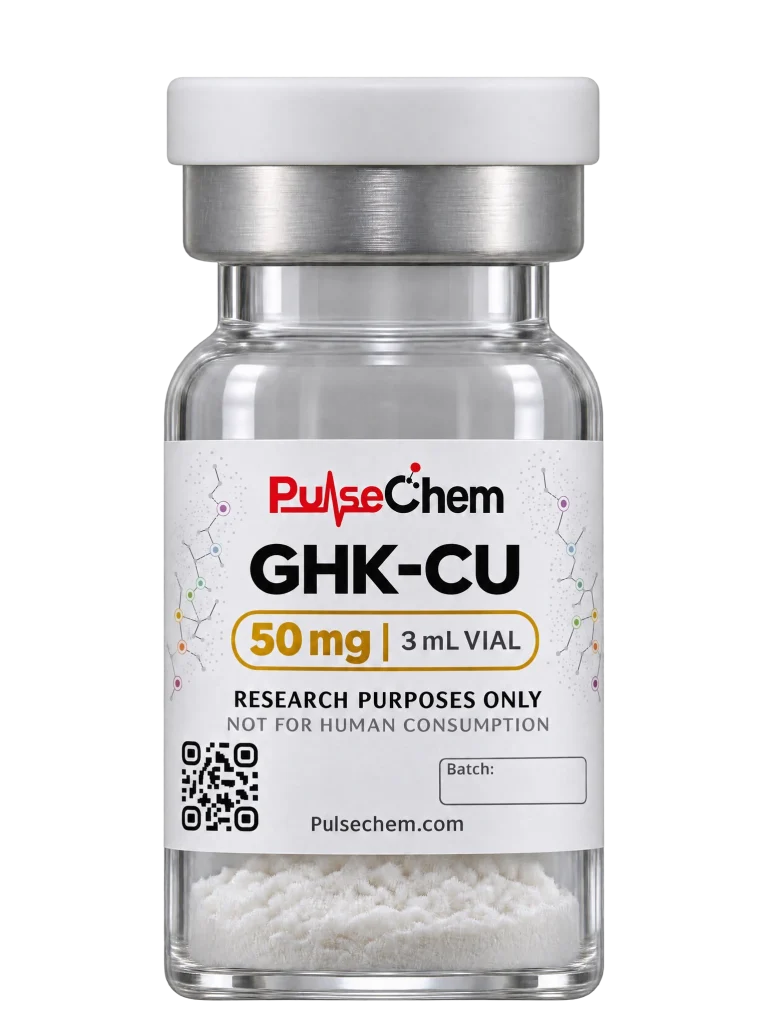
GHK-Cu at PulseChem. GHK-Cu is available in 50 and 100 mg and in the blends GHK-Cu + BPC-157 + TB-500 and GHK-Cu + BPC-157 + TB-500 + KPV. The certificate of analysis for each batch is on the product page and on Lab results, where you search by batch number. For laboratory research only; see RUO explained.
Sources
Consulted in November 2026.
- glycyl-L-histidyl-L-lysine (GHK) (PubChem), CID 73587: formula, mass, CAS number, synonyms, and INCI name
- Prezatide copper (GHK-Cu) (PubChem), CID 71587328: formula, mass, CAS number, synonyms, INCI name, and description from DrugBank (DB14683)
- Pickart L., Thaler M.M. (1973), Tripeptide in human serum which prolongs survival of normal liver cells and stimulates growth in neoplastic liver, Nature New Biology 243:85-87 (PubMed), PMID 4349963
- Schlesinger D.H., Pickart L., Thaler M.M. (1977), Growth-modulating serum tripeptide is glycyl-histidyl-lysine, Experientia (PubMed), PMID 858356
- Pickart L., Thaler M.M., Millard M. (1979), Effect of transition metals on recovery from plasma of the growth-modulating tripeptide glycylhistidyllysine, J Chromatogr (PubMed), PMID 546910
- Maquart F.X. et al. (1988), Stimulation of collagen synthesis in fibroblast cultures by the tripeptide-copper complex glycyl-L-histidyl-L-lysine-Cu2+, FEBS Lett 238:343-346 (PubMed), PMID 3169264
- Pickart L., Vasquez-Soltero J.M., Margolina A. (2015), GHK Peptide as a Natural Modulator of Multiple Cellular Pathways in Skin Regeneration, BioMed Res Int (PubMed), PMID 26236730
- Prezatide copper acetate [USAN:INN] (ChemIDplus, via PubChem) and PREZATIDE COPPER ACETATE, UNII A3LEI4P1NB (FDA Global Substance Registration System): CAS 130120-57-9, two GHK on one copper ion with acetate
- Prezatide copper acetate (PubChem, NCBI), CID 9876021: C32H54CuN12O12, synonym BIS(TRIPEPTIDE-1) COPPER ACETATE
- CosIng, database of cosmetic ingredients and the user guide with disclaimer (European Commission)
- Regulation (EC) No 1223/2009 on cosmetic products, Article 2 (EUR-Lex)
This article is background information on laboratory research. It is not medical advice or instructions for use. All products are for research use only.