What is a COA?
A certificate of analysis tells you what is in a batch and how it was measured. How to read one, and how to check that it belongs to your vial.
Check the spelling or search for part of the name, such as BPC or GHK. Or choose below.
Popular searches
Go to
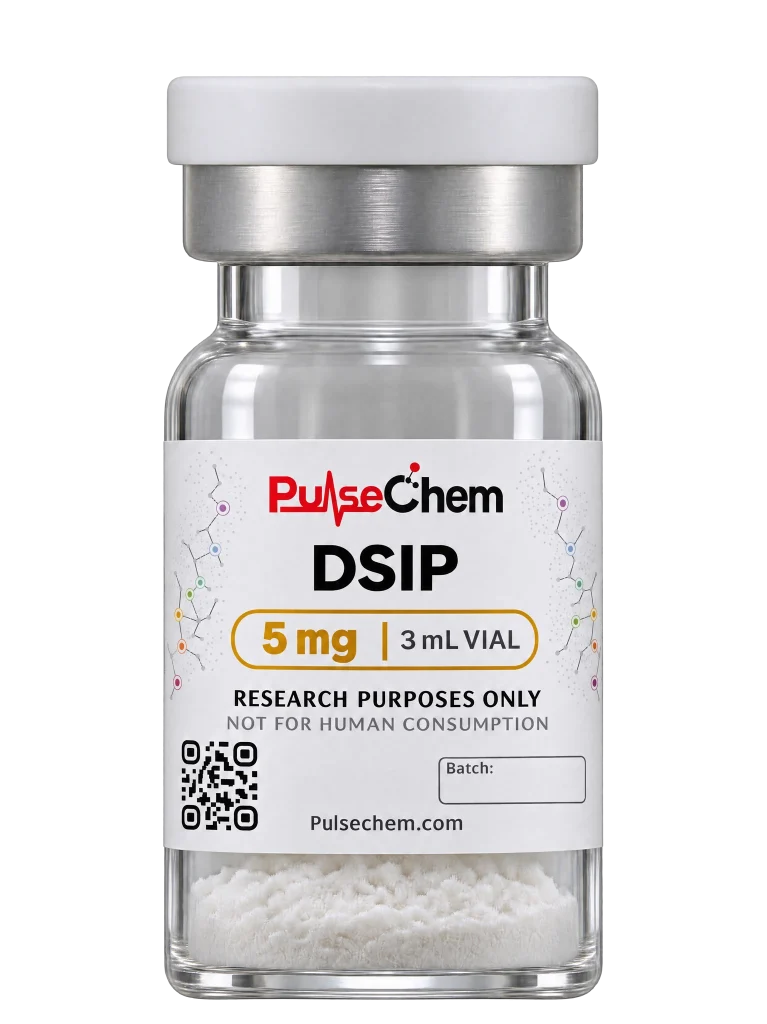
DSIP is a synthetic peptide of 9 amino acids, a nonapeptide first described in 1977 after its isolation from rabbit blood. Buy DSIP for laboratory research from PulseChem: 5 mg of lyophilized powder per vial, ≥99% purity by HPLC and a COA for every batch.
€41.45 incl. VAT · €34.26 excl. VAT
In stock
Volume discount
Research Use Only. For laboratory research use only (in vitro). Not for human or animal use. The products are not medicines, foods, or cosmetics. They are not intended to diagnose, treat, cure, or prevent any disease. The information on this website has not been evaluated by the EMA, the Romanian National Agency for Medicines and Medical Devices (ANMDMR), or the FDA. Read the RUO policy
This is how solutions are prepared in the lab.
Step 1 of 8: Disinfect
The stoppers of both vials are wiped with an alcohol swab.
For laboratory research use only (in vitro). Not for human or animal use.
Research area: Brain
Sequence: H-WAGGDASGE-OH
Structure from PubChem, CID 68816. Schematic in 3D, not a measured structure.
Schematic view of the chain. This is not a measured 3D structure.
Point to an amino acid or use the arrow keys to see its name.
Drag or use the arrow keys to rotate the diagram. Point to a bead to see the name of the amino acid.
The chain has 9 amino acids, shown here from the N-terminus to the C-terminus. Calculated average molecular mass: 848.8 g/mol. Compare this figure with the mass on the certificate of analysis.
On the research map: Brain and pituitary
The batch number is on the vial label. You can find the certificate of analysis for that batch on the Lab results page or request it from us.
| Contents | 5 mg per vial |
|---|---|
| Sequence | H-Trp-Ala-Gly-Gly-Asp-Ala-Ser-Gly-Glu-OH |
| Purity | ≥99% (HPLC) |
| Intended use | For laboratory research use only (RUO) |
Every sealed glass vial contains 5 mg of DSIP as a lyophilized (freeze-dried) powder. The label shows the amount and the batch number, the number under which that batch's certificate of analysis is filed.
PulseChem offers DSIP for sale to anyone aged 18 or over who is buying for laboratory research, as a guest or with an account. You confirm research use at checkout.
DSIP is a nonapeptide: a chain of nine amino acids with free ends. G.A. Schoenenberger and M. Monnier described it in 1977 in the Proceedings of the National Academy of Sciences (PNAS). The peptide had been isolated from rabbit blood, and the same paper also describes the synthetic form.
In the literature, the peptide is known by the abbreviation DSIP. PubChem lists, among others, the CAS number 62568-57-4.
An external laboratory measures purity by HPLC (≥99%) and checks identity by mass spectrometry. As early as 1978, Schoenenberger and colleagues (Pflügers Archiv) distinguished a β-aspartyl variant of DSIP. Such a variant has the same mass, which is why both measurements belong on the COA. Look up your batch number on Lab results.
Keep the vial closed, cool, dry and dark, as the label and COA state. PulseChem ships from Europe in insulated packaging with tracking, adding a cold pack in warm weather. An order placed and paid before 3 p.m. Central European time on a working day is dispatched the same day, and delivery takes 1–3 working days within Europe. Shipping within the EU only.
For laboratory research only, not for human or animal use.
DSIP is available from PulseChem in this web shop. The 5 mg vial costs €41.45 including VAT, and DSIP is in stock. An order received and paid before 3 p.m. Central European time on a working day leaves the same day; delivery takes 1–3 working days within Europe. Each batch has its own COA.
A vial of DSIP holds 5 mg of synthetic DSIP as a lyophilized (freeze-dried) powder, in a sealed glass vial. The label gives the amount and the batch number. With that number, Lab results shows the COA with the measured purity of that exact batch.
DSIP ships from Europe in insulated packaging with tracking, with a cold pack in warm weather. Once it arrives, keep the vial closed, cool, dry and dark, following the label and COA. PulseChem delivers within the EU only, and delivery takes 1–3 working days within Europe.
DSIP is a nonapeptide that Schoenenberger and Monnier described in 1977 in PNAS, after it had been isolated from rabbit blood. The same paper also describes the synthetic form. The DSIP sold by PulseChem is made synthetically and is a research chemical, for laboratory research only.
A certificate of analysis tells you what is in a batch and how it was measured. How to read one, and how to check that it belongs to your vial.
A purity of 99% tells you about the composition of the peptide, not about the amount in the vial. What the number measures, and what it does not.
Peptides are supplied as a freeze-dried powder because they break down quickly in solution. What happens during freeze-drying, and what it means for storage.
This conversation is stored so we can answer your question. More in the privacy policy.