What is a COA?
A certificate of analysis tells you what is in a batch and how it was measured. How to read one, and how to check that it belongs to your vial.
Check the spelling or search for part of the name, such as BPC or GHK. Or choose below.
Popular searches
Go to
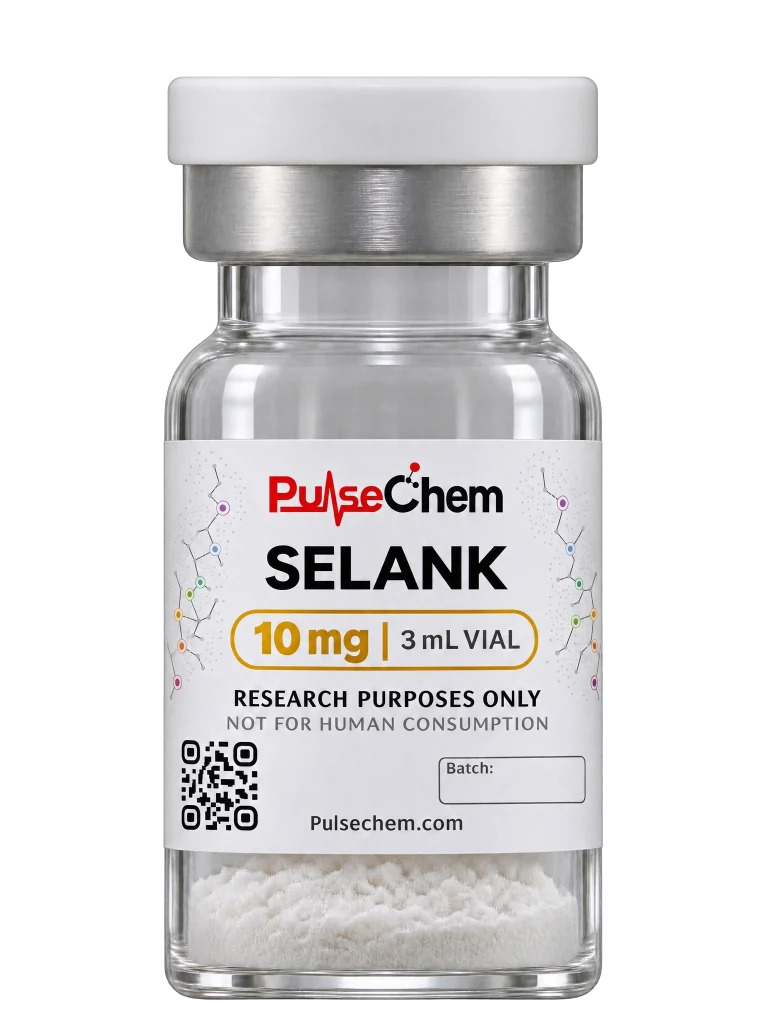
Selank is a synthetic peptide of 7 amino acids, built from the tetrapeptide tuftsin followed by the sequence Pro-Gly-Pro. Buy Selank for laboratory research from PulseChem and you get 10 mg of lyophilized powder per vial, ≥99% purity by HPLC and a COA for every batch.
€57.45 incl. VAT · €47.48 excl. VAT
In stock
Volume discount
Research Use Only. For laboratory research use only (in vitro). Not for human or animal use. The products are not medicines, foods, or cosmetics. They are not intended to diagnose, treat, cure, or prevent any disease. The information on this website has not been evaluated by the EMA, the Romanian National Agency for Medicines and Medical Devices (ANMDMR), or the FDA. Read the RUO policy
This is how solutions are prepared in the lab.
Step 1 of 8: Disinfect
The stoppers of both vials are wiped with an alcohol swab.
For laboratory research use only (in vitro). Not for human or animal use.
Research area: Brain
Sequence: H-TKPRPGP-OH
Structure from PubChem, CID 11765600. Schematic in 3D, not a measured structure.
Schematic view of the chain. This is not a measured 3D structure.
Point to an amino acid or use the arrow keys to see its name.
Drag or use the arrow keys to rotate the diagram. Point to a bead to see the name of the amino acid.
The chain has 7 amino acids, shown here from the N-terminus to the C-terminus. Calculated average molecular mass: 751.9 g/mol. Compare this figure with the mass on the certificate of analysis.
On the research map: Brain and pituitary
The batch number is on the vial label. You can find the certificate of analysis for that batch on the Lab results page or request it from us.
| Contents | 10 mg per vial |
|---|---|
| Sequence | H-Thr-Lys-Pro-Arg-Pro-Gly-Pro-OH |
| Purity | ≥99% (HPLC) |
| Intended use | For laboratory research use only (RUO) |
Selank comes in a sealed glass vial with 10 mg of lyophilized (freeze-dried) powder. The label states the amount and the batch number, so each vial belongs to exactly one certificate of analysis.
PulseChem has Selank for sale to guests and account holders alike. You need to be 18 or over and buying for laboratory research, and you confirm research use at checkout.
Selank is a heptapeptide that builds on tuftsin. Najjar and Nishioka described tuftsin in 1970 in Nature as a tetrapeptide derived from immunoglobulin G. In Selank, those four amino acids are followed by proline, glycine and proline.
According to Volkova and colleagues at the Institute of Molecular Genetics of the Russian Academy of Sciences in Moscow (Frontiers in Pharmacology, 2016), Selank was designed there, together with the Zakusov Research Institute of Pharmacology, as a synthetic analog of tuftsin. PubChem lists the CAS number 129954-34-3.
Every batch goes to an external laboratory: HPLC for purity (≥99%), mass spectrometry for identity. With electrospray, Selank appears near m/z 752.4 and Semax near 814.4, among other ions, so the mass measurement tells these two related peptides apart at once. Your batch number leads to the COA via Lab results.
Store Selank in the closed vial, cool, dry and dark, as the label and COA state. Shipping is from Europe, in insulated packaging with tracking and a cold pack in warm weather. If your order is received and paid before 3 p.m. Central European time on a working day, it goes out the same day; delivery takes 1–3 working days within Europe. EU only.
For laboratory research only, not for human or animal use.
Selank is available from PulseChem in this web shop. A 10 mg vial costs €57.45 including VAT; Selank is in stock. Orders received and paid before 3 p.m. Central European time on a working day are on their way the same day, with delivery in 1–3 working days within Europe. PulseChem supplies a COA with every batch.
A vial of Selank contains 10 mg of synthetic Selank as a lyophilized (freeze-dried) powder, sealed in glass. The label shows the amount and the batch number. The COA for that batch, with the purity and the mass measurement, is on Lab results.
The purity of Selank is measured for every batch by an external laboratory using HPLC, with ≥99% as the lower limit. Mass spectrometry confirms that the vial contains Selank and not a related peptide such as Semax. Both measurements are on the COA of the batch, which matches the batch number on the label.
Selank and Semax differ in their first four amino acids. Selank starts with tuftsin (Thr-Lys-Pro-Arg), Semax with ACTH(4-7) (Met-Glu-His-Phe). Both peptides have seven amino acids, end in Pro-Gly-Pro and come from the Institute of Molecular Genetics in Moscow. PulseChem supplies them as two separate products.
A certificate of analysis tells you what is in a batch and how it was measured. How to read one, and how to check that it belongs to your vial.
A purity of 99% tells you about the composition of the peptide, not about the amount in the vial. What the number measures, and what it does not.
Peptides are supplied as a freeze-dried powder because they break down quickly in solution. What happens during freeze-drying, and what it means for storage.
This conversation is stored so we can answer your question. More in the privacy policy.