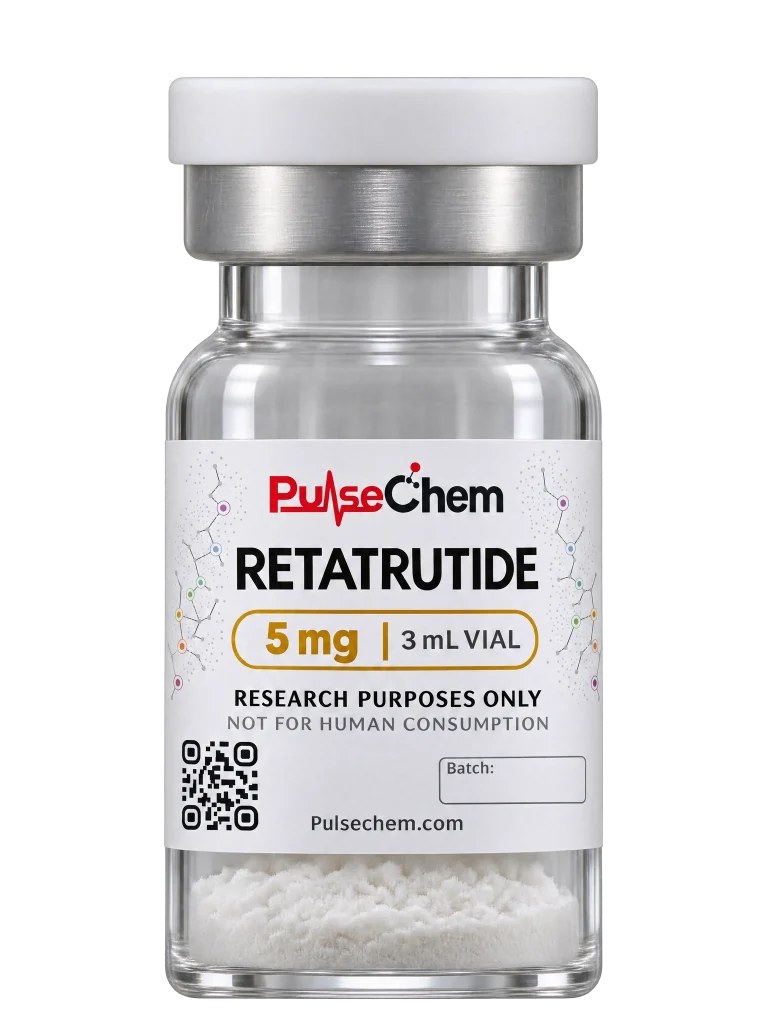
Retatrutide is an investigational peptide from Eli Lilly, with the code LY3437943. It was designed to act on three hormone receptors: those for GIP, GLP-1, and glucagon. Retatrutide is still under investigation and is not authorized as a medicine. The material from PulseChem is a research chemical, not Lilly’s study drug.
Structure
Retatrutide is a single peptide chain. According to the structure in PubChem, the chain has 39 amino acids, three of which are not among the twenty standard amino acids. A long fatty chain is attached to one lysine. A peptide carrying a fatty acid like this is called lipidated.
| Property | Value |
|---|---|
| Code | LY3437943 |
| Compound class | Synthetic, lipidated peptide of 39 amino acids |
| Non-standard building blocks | Aib (α-aminoisobutyric acid) at positions 2 and 20, α-methylleucine at position 13 |
| Side chain | The lysine at position 17 carries a diacid with twenty carbon atoms, attached through a short linker (AEEA and γ-glutamic acid) |
| C-terminus | Amide |
| Molecular formula | C221H342N46O68 |
| Molecular weight (average) | 4731 g/mol |
| Monoisotopic mass | 4728.47 Da |
| CAS number | 2381089-83-2 (KEGG DRUG, FDA substance registry) |
| PubChem CID | 171934787 and 171390338 (see below) |
A note on PubChem. It holds several records with this molecular formula and mass, but none of them is simply called retatrutide, and a search on that name returns no record in PubChem at all. The record PulseChem uses for its molecule drawing (CID 171934787) is titled Retatrutide (sodium salt), although its formula contains no sodium. CID 171390338 is titled Triple G. The formula and mass in the table are those of the peptide itself and match the structure recorded in the FDA’s substance registry (UNII NOP2Y096GV). The CAS number is listed in KEGG DRUG (D12430) and in that registry.
How to recognize modifications such as Aib and an amide in a sequence is explained in How to read a peptide sequence. What sets a peptide with a fatty chain apart from an ordinary peptide is covered in What are peptides?
Origin and research
Lilly researchers described LY3437943 in Cell Metabolism in 2022 (Coskun and colleagues), from its discovery in the laboratory to a first clinical study. Larger studies followed. Two publications from phase 2:
- Jastreboff and colleagues (2023), New England Journal of Medicine. A randomized, double-blind, placebo-controlled phase 2 study in 338 adults with obesity or overweight, without type 2 diabetes, over 48 weeks. The primary endpoint was the percentage change in body weight at 24 weeks; the change at 48 weeks was a secondary endpoint.
- Sanyal and colleagues (2024), Nature Medicine. A randomized substudy (phase 2a) within the same phase 2 study, in the 98 participants with at least 10% liver fat, measured by MRI. The primary endpoint was the relative change in liver fat at 24 weeks.
This article deliberately gives no outcome figures. They concern research in humans under medical supervision and say nothing about the research material you use in a laboratory.
Status on November 14, 2026
Retatrutide has been studied in phase 3 in the TRIUMPH program. Three studies from that program:
- TRIUMPH-1 (NCT05929066), in adults with obesity or overweight; listed in the register as completed on 30 April 2026.
- TRIUMPH-2 (NCT05929079), in adults with obesity or overweight and type 2 diabetes; completed on 16 June 2026.
- TRIUMPH-3 (NCT05882045), in adults with severe obesity and cardiovascular disease; completed on 14 May 2026.
None of these three studies has results posted in the register. Retatrutide is therefore still an investigational compound, with no authorization as a medicine from the FDA or the EMA. Why that matters for research material is explained in RUO explained.
In the lab
Retatrutide is a large, lipidated peptide. That affects the analysis:
- Mass spectrometry. With electrospray ionization, a molecule of this size picks up several protons at once. You then see a series of peaks with different charges, for example at around m/z 1578 (three charges), 1184 (four), and 947 (five), calculated from the average mass of 4731. Software converts that series back into a single mass. How that works is covered in How to read a mass spectrum.
- Purity and peptide content. HPLC measures what share of the signal comes from retatrutide. How much of the powder is actually peptide is a different question: counterions and water count toward the weight. The difference is explained in What 99% purity means.
- Storage. Keep the lyophilized powder closed, cool, and dark, at the temperature on the label, and let a cold vial reach room temperature before you open it.
A related peptide with a fatty chain is cagrilintide, an analogue of amylin.
Retatrutide at PulseChem. Retatrutide is available from 5 to 60 mg per vial. The certificate of analysis for each batch is on the product page and on Lab results, where you search by batch number. It is intended for laboratory research only and not for humans or animals.
Sources
Consulted in November 2026.
- Retatrutide (sodium salt), CID 171934787, and Triple G, CID 171390338 (PubChem): structure, formula, and mass
- Retatrutide (KEGG DRUG), D12430: CAS number
- RETATRUTIDE, UNII NOP2Y096GV (FDA Global Substance Registration System): structure, code LY3437943, and CAS number
- Coskun T. et al. (2022), LY3437943, a novel triple glucagon, GIP, and GLP-1 receptor agonist for glycemic control and weight loss: From discovery to clinical proof of concept, Cell Metab 2022;34(9):1234-1247.e9 (PubMed), PMID 35985340, doi 10.1016/j.cmet.2022.07.013
- Jastreboff A.M. et al. (2023), Triple-Hormone-Receptor Agonist Retatrutide for Obesity: A Phase 2 Trial, N Engl J Med 2023;389(6):514-526 (PubMed), PMID 37366315, doi 10.1056/NEJMoa2301972
- Sanyal A.J. et al. (2024), Triple hormone receptor agonist retatrutide for metabolic dysfunction-associated steatotic liver disease: a randomized phase 2a trial, Nat Med 2024;30(7):2037-2048 (PubMed), PMID 38858523, PMC11271400, doi 10.1038/s41591-024-03018-2
- A Study of LY3437943 in Participants Who Have Obesity or Are Overweight (ClinicalTrials.gov), NCT04881760: the phase 2 study of Jastreboff and Sanyal, 338 participants, completed, with type 1 and type 2 diabetes as exclusion criteria
- TRIUMPH-1, NCT05929066, TRIUMPH-2, NCT05929079, and TRIUMPH-3, NCT05882045 (ClinicalTrials.gov): phase 3, all three completed in 2026, with no results posted in the register (consulted on 14 November 2026)
This article is background information on laboratory research. It is not medical advice or instructions for use. All products are for research use only.