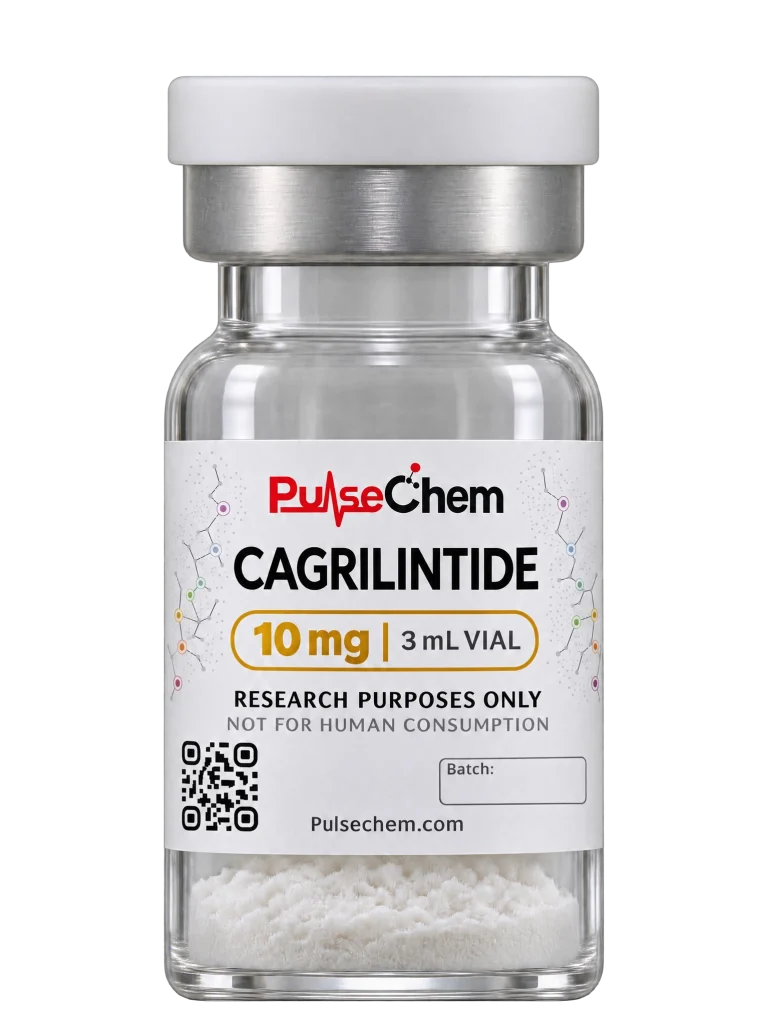
Cagrilintide is a synthetic peptide derived from the hormone amylin. Novo Nordisk developed it as a long-acting analogue, and it is being studied in clinical trials, on its own and in combination with semaglutide. Cagrilintide is not authorised as a medicine. The material sold by PulseChem is a research chemical, not Novo Nordisk’s study drug.
Amylin in brief
Amylin is also called islet amyloid polypeptide (IAPP). According to the description in PubChem (from MeSH), it is a hormone of the beta cells of the pancreas that is co-secreted with insulin. It is a chain of 37 amino acids with a disulfide bridge between the cysteines at positions 2 and 7 and an amide at the end. UniProt gives the longer precursor protein (P10997) of 89 amino acids; the 37 residues of amylin sit at positions 34 to 70 within it.
The same description mentions a property that makes amylin difficult to work with: it can fold into amyloid fibrils. Kruse and colleagues (2021) cite this tendency to form fibrils as the reason why designing an analogue was a challenge. An amylin analogue already existed, pramlintide, but according to the same authors it has a short half-life.
Structure
Cagrilintide is a chain of 37 amino acids with a fatty acid at the start. A peptide with a fatty acid chain like this is called lipidated. According to the systematic name among the PubChem synonyms, a diacid with twenty carbon atoms is attached through a gamma-glutamic acid to the first amino acid, a lysine. The end is an amide (prolinamide), and the cysteines at positions 2 and 7 form a disulfide bridge, in the same place as in amylin. That name counts the gamma-glutamic acid as the first building block and therefore writes the bridge as 3->8.
In PubChem notation the sequence is XKCNTATCATQRLAEFLRHSSNNFGPILPPTNVGSNTP, where X stands for the fatty acid with its linker. How to read such a code is explained in How to read a peptide sequence.
| Property | Value |
|---|---|
| Compound class | Synthetic, lipidated peptide of 37 amino acids (amylin analogue) |
| N-terminus | C20 diacid attached via gamma-glutamic acid to lysine 1 |
| Disulfide bridge | Cys2-Cys7 |
| C-terminus | Amide |
| Molecular formula | C194H312N54O59S2 |
| Molecular weight (average) | 4409 g/mol |
| Monoisotopic mass | 4406.25 Da |
| CAS number | 1415456-99-3 |
| PubChem CID | 171397054 |
Put the sequence next to that of human amylin in PubChem and they differ at six of the 37 positions: 14 (asparagine becomes glutamic acid), 17 (valine becomes arginine), 25, 28 and 29 (an alanine and two serines become proline) and 37 (tyrosine becomes proline). A second PubChem record (CID 167312356) has the same order but a different L or D notation at several positions. This article therefore gives no stereochemistry.
Research
The main publications, with their design and outcome measure. This article deliberately gives no results in numbers and no amounts: these are studies in humans under medical supervision, and they say nothing about research material in a laboratory.
- Kruse and colleagues (2021), Journal of Medicinal Chemistry. Novo Nordisk researchers describe the development of cagrilintide (compound 23 in the paper) and part of the structure-activity work that led to this analogue being chosen for clinical development.
- Lau and colleagues (2021), The Lancet. A randomised, double-blind, multicentre phase 2 trial in 706 participants with overweight or obesity. Cagrilintide was compared with placebo and with liraglutide. The primary outcome measure was the percentage change in body weight after 26 weeks.
- REDEFINE 1, Garvey and colleagues (2025), New England Journal of Medicine. A double-blind phase 3a trial of 68 weeks in 3,417 adults with overweight or obesity (NCT05567796). The combination of cagrilintide and semaglutide, called CagriSema, was compared with each drug alone and with placebo.
- REDEFINE 2, Davies and colleagues (2025), New England Journal of Medicine. A double-blind, placebo-controlled phase 3a trial of 68 weeks in adults with overweight or obesity and type 2 diabetes (NCT05394519).
The PubChem record also names trial NCT06221969, which compares CagriSema with tirzepatide in people with type 2 diabetes treated with metformin, with or without an SGLT2 inhibitor.
Status on 14 November 2026
On 18 December 2025 Novo Nordisk submitted a New Drug Application to the US FDA for CagriSema, the fixed combination of cagrilintide and semaglutide, for weight management in adults with obesity or overweight. In the same announcement the company states that CagriSema is not approved in the United States or the EU. In its report of 4 November 2026 on the third quarter, Novo Nordisk expected an FDA decision in the fourth quarter of 2026. We found no published decision on 14 November 2026: CagriSema is not in the FDA list of novel drugs approved in 2026 (updated to 9 November 2026), and the EMA medicines database lists no marketing authorisation for cagrilintide or CagriSema.
Cagrilintide as a single agent is not authorised either. ClinicalTrials.gov lists the phase 3 trials RENEW 1 (NCT07220642) and RENEW 2 (NCT07220759), which started in November 2025 and compare cagrilintide without semaglutide with placebo; Novo Nordisk’s 2025 annual report mentions them too. Since August 2026, RENEW 4 (NCT07745504) has also been recruiting participants. Why that status matters for research material is explained in RUO explained.
In the lab
- Mass spectrometry. In electrospray ionisation a molecule of more than 4,400 daltons picks up several protons at once. You then see a series of peaks with different charges; calculated from the average mass of 4409, for example around m/z 1470.7 (three charges), 1103.3 (four) and 882.8 (five). Software converts that series back to a single mass. How that works is covered in How to read a mass spectrum.
- Purity and peptide content. HPLC measures what share of the signal comes from cagrilintide. How much of the powder is actually peptide is a different question, because counterions and water count towards the weight. The difference is explained in What does 99% purity mean?.
- Storage. Keep the lyophilised powder closed, cool and dark, at the temperature on the label, and let a cold vial reach room temperature before you open it.
A related peptide with a fatty acid chain is retatrutide. What peptides are in general is covered in What are peptides?
Cagrilintide at PulseChem. Cagrilintide is available at 10 mg per vial. The certificate of analysis for every batch is on the product page and on Lab results, where you search by batch number. It is intended for laboratory research only and not for humans or animals.
Sources
Consulted in November 2026.
- Cagrilintide (PubChem, NCBI), CID 171397054: sequence in PubChem notation, systematic name among the synonyms (with analogue 23 from PMID 34288673), C194H312N54O59S2, molecular weight 4409, CAS 1415456-99-3, descriptions from MeSH and DrugBank with trial NCT06221969
- Islet Amyloid Polypeptide (PubChem, NCBI), CID 16132430: sequence of human amylin, disulfide bridge 2-7, C-terminal amide, description from MeSH
- Islet amyloid polypeptide (human) (UniProt), P10997: precursor protein of 89 amino acids, amylin at positions 34-70
- Kruse T et al. Development of Cagrilintide, a Long-Acting Amylin Analogue (J Med Chem 2021;64(15):11183-11194), PMID 34288673
- Lau DCW et al. Once-weekly cagrilintide for weight management in people with overweight and obesity: a multicentre, randomised, double-blind, placebo-controlled and active-controlled, dose-finding phase 2 trial (Lancet 2021;398(10317):2160-2172), PMID 34798060
- Garvey WT et al. Coadministered Cagrilintide and Semaglutide in Adults with Overweight or Obesity (N Engl J Med 2025;393(7):635-647), PMID 40544433, REDEFINE 1
- Davies MJ et al. Cagrilintide-Semaglutide in Adults with Overweight or Obesity and Type 2 Diabetes (N Engl J Med 2025;393(7):648-659), PMID 40544432, REDEFINE 2
- NCT05567796 (REDEFINE 1), NCT05394519 (REDEFINE 2) and NCT06221969 (ClinicalTrials.gov)
- NCT07220642 (RENEW 1), NCT07220759 (RENEW 2) and NCT07745504 (RENEW 4) (ClinicalTrials.gov): phase 3, start dates 5 November 2025 and 4 August 2026
- Novel Drug Approvals for 2026 (FDA, updated to 9 November 2026) and the EMA medicines database (data of 13 November 2026): no approval of CagriSema or cagrilintide
- Novo Nordisk files for FDA approval of CagriSema, the first once-weekly combination of GLP-1 and amylin analogues for weight management (Novo Nordisk, 18 December 2025)
- Innovation and therapeutic focus (Novo Nordisk, Annual Report 2025): CagriSema submission in the US, start of RENEW 1 and RENEW 2
- Novo Nordisk A/S, Form 6-K with the third-quarter 2026 report (SEC EDGAR, 4 November 2026): FDA decision on CagriSema expected in the fourth quarter of 2026
This article is background information on laboratory research. It is not medical advice or instructions for use. All products are for research use only.